
The Collector’s Shelf
Xbox
Explore original Xbox history through Mattel’s console build, from the 2001 launch and Halo to online play and hardware nostalgia.

Pre-order: Xbox
All pre-orders →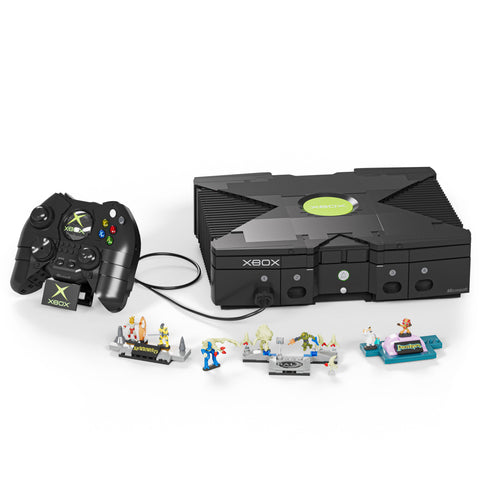
Explore original Xbox history through Mattel’s console build, from the 2001 launch and Halo to online play and hardware nostalgia.
A hardware theme with a precise starting point
Mystery Collective’s Xbox theme currently centers on the Mattel Brick Shop Microsoft XBOX Building Set. This is a collectible interpretation of the original console, not a listing for gaming hardware or a general catalog of every Xbox generation. That distinction gives the page a useful focus: the physical object associated with an early gaming experience, and the history that makes its shape meaningful.
Microsoft’s contemporary launch announcement dates the North American Xbox release to November 15, 2001. It names Halo among the launch titles, alongside games such as Project Gotham Racing and Oddworld: Munch’s Oddysee. A launch announcement captures one particular moment; it should not be confused with everything that later appeared on the platform. When recording a personal Xbox collection, distinguish console launch, game release and collectible manufacture. Those dates answer different questions and help prevent a modern tribute from being described as an original-era artifact.
Remembering an object as well as a game
A games console can carry memories that are not contained in a screenshot: where it sat, who held the controller, and which sound announced that a session was beginning. A construction model works with those memories differently from a character figure. It places the machine itself at the center, encouraging the owner to look again at an object that may once have disappeared into the background of play.
For this kind of collection, personal specificity is more useful than a ranking of the greatest consoles. Write down which game or shared experience makes the original Xbox meaningful to you. If your strongest memory belongs to a later generation, acknowledge that rather than treating every Xbox-shaped object as the same historical reference. A display can include different generations, but labels should make the relationship clear. The result becomes a small account of how you encountered games, rather than a row of unexplained electronic silhouettes.
The network story came in stages
Xbox’s official tenth-anniversary retrospective dates Xbox Live’s launch to November 15, 2002, a year after the original console. It recalls that the machine already included a network port before the service was available and names MechAssault, NFL Fever and Ghost Recon among the early online games. This sequence matters because a familiar piece of hardware can represent changing experiences over its lifetime.
A collector’s label might therefore separate the console’s arrival from the online milestone instead of compressing both into a single launch story. That distinction also leaves room for different memories: playing beside a friend and connecting with someone elsewhere are not identical experiences. Neither needs to replace the other in a personal display. The model can serve as a prompt for both, but it does not restore the original service or provide online play. Treat historical network features as context for the real console, not as capabilities of the brick-built tribute.
Halo and the wider memory of the platform
In its 2021 twentieth-anniversary account, Xbox celebrated Halo’s twentieth anniversary alongside its own. The retrospective describes Master Chief’s arrival on a ringworld as a defining part of the Xbox experience. This is a documented connection between platform and fictional world, rather than a reason to reduce the entire console’s library to one game. A hardware collection can accommodate the title that introduced you to it and the unexpected favorite that kept you playing.
The anniversary article also contrasts early living-room play with later experiences across console, PC and mobile. For a collector, that change helps explain why a physical representation of the original machine can feel particularly specific. It fixes one recognizable object within a much broader platform history. Keep contemporary service names and availability out of an evergreen description unless they are being checked separately. Historical context should explain the collectible, not turn its page into an unreliable guide to current subscriptions or compatibility.
The catalog model opens onto game worlds
Mattel identifies the set as HYL44 and describes a one-to-one-scale build of the original Xbox with a buildable Duke controller. Buttons trigger four light-and-sound sequences, and opening the console activates its startup sequence. Three slot-in dioramas represent Psychonauts, Halo and The Elder Scrolls III: Morrowind, accompanied by one-inch NanoWorld figures. These are model features, not playable copies of those games.
The internal scenes create a useful curatorial choice. Displaying the exterior emphasizes the hardware; revealing a diorama emphasizes a remembered world. Try both arrangements before deciding which best communicates your interest. Do not describe the three represented games as a shared launch lineup simply because they appear together in one modern set. The manufacturer has assembled a retrospective selection. That is a creative presentation decision, and recognizing it makes the model more interesting than treating it as a frozen inventory of launch day.
Make the display tell your own gaming history
One effective arrangement is to keep the console model as the visual anchor and add a short account of the experience it represents. A photograph of your own former setup or a handwritten memory can be more informative than unrelated branded objects. If you include original game packaging, identify it separately from the modern construction set so visitors understand what is contemporary and what is retrospective.
Think about interaction as part of display rather than an afterthought. A model intended to be opened deserves room around it, while small removable scenes need a consistent storage place when not in use. Keep any operating instructions available for the light-and-sound features. The strongest reason to choose this Xbox collectible is not that it replaces a console, but that it allows the console’s design and associated memories to become the subject. That narrower purpose distinguishes a satisfying hardware tribute from an indiscriminate collection of gaming logos.
FAQs
Can the Mattel Xbox building set run original Xbox games?
No. It is a construction model with display scenes and light-and-sound features, not functioning gaming hardware.
Did Xbox Live launch with the original console?
No. The North American console launch was November 15, 2001; Xbox Live followed on November 15, 2002.
Sources
Pre-orders
Pre-orders are open
Reserve upcoming releases before they land. Full refund any time before it ships.