
Collection
Union Arena Collectibles & collecting guide
 Trading Cards
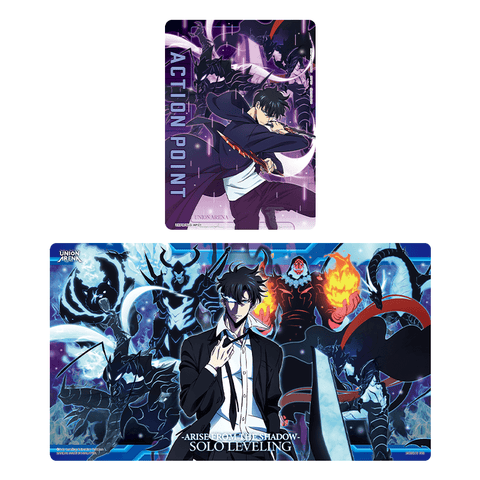
Union Arena Playmat & Action Point Cards Set Solo Leveling
Bandai
 Trading Cards
Union Arena Playmat & Action Point Cards Set Kagurabachi
Bandai
Explore Union Arena’s shared rules, title-specific decks, early English products and ways to compare starter decks and booster releases.
One rules system, several entertainment worlds
Union Arena describes itself as a common-rules trading-card game: players learn one system and use characters from series they enjoy. That makes it different from a brand page devoted to one fictional universe. The game label connects products across several titles, while each title retains its own character and visual identity. A fan can begin with a familiar series without assuming that every other product belongs in the same deck or collection.
The most useful first question is which world you want to explore. Then decide whether the aim is learning the game, collecting particular illustrations or building a more developed deck. Those goals can overlap, but they lead to different product comparisons. A broad interest in anime does not require collecting every Union Arena title. Choosing one manageable starting point lets you understand the cards and their identifiers before the wider range becomes another layer of decisions.
An early English milestone with Bleach
The official North American product page for the Bleach: Thousand-Year Blood War starter deck, UE01ST, records a September 27, 2024 release date. It describes a ready-to-play fifty-card deck, three Action Point cards and a playsheet. This is a concrete early English-market reference point, with a defined starting product rather than a vague promise of crossover collecting. The date belongs to that regional product and should not be presented as the origin of every Union Arena edition worldwide.
For historical comparisons, keep the market and product code beside the title. A release in another language may have a different schedule or packaging, and a matching character image is not enough to establish equivalent contents. If you are choosing a first deck, use the current listing and rules to confirm what is supplied and what else a session needs. A historical starter remains useful context even when your preferred series entered the range later.
Shared rules do not mean unrestricted mixing
The official beginner guide says a Union Arena deck contains fifty cards from the same series, using Character, Site and Event cards. It explicitly states that cards from different series cannot be included in the same deck. This is the key distinction behind the common-rules concept: separate fictional worlds can use one game system without becoming an unrestricted mixture of every character you recognize.
That distinction also helps a collector stay organized. Keep series groupings visible in your binder or storage, and preserve the card numbers when comparing versions. If you want to learn several titles, treat them as separate projects rather than assuming one broad purchase pool will supply everything equally. For a shared game night, check that each participant has a suitable deck and the required materials. Familiarity with one rules system can make another title easier to explore, but it does not remove the need to read its cards.
Expansions can revisit a title or introduce another
The official North American site presents titles including Bleach, Hunter x Hunter, Demon Slayer, Sword Art Online and Evangelion: New Theatrical Edition. Mystery Collective's catalog mirrors that variety with Demon Slayer Vol.2 and Sword Art Online Vol.2 boosters, as well as Evangelion starter and booster entries. These are different kinds of expansion: revisiting an established title is not the same collecting proposition as beginning a new one.
Before following a second volume, compare its official card list with the scope of your existing project. You may want additional versions of a favorite character, or you may prefer to finish a smaller checklist first. Before adding a new title, consider whether the attraction is the artwork, the series itself or the way its deck plays. A deliberate reason for branching out makes the collection easier to maintain than treating every newly announced property as an automatic continuation of what you already own.
Product codes clarify the item being compared
The catalog identifies Evangelion: New Theatrical Edition with separate UE15ST starter and UE15BT booster entries. It also includes playmat and Action Point card sets for Kagurabachi and Solo Leveling. Those examples show why the series name alone cannot identify the product. A starter deck, booster and accessory set have different contents and different roles, even when they use artwork from the same fictional world.
Record the full code, language and unit being offered before comparing listings. If a product is a booster display rather than an individual pack, make that distinction explicit in your notes. If an accessory includes promotional cards, verify the exact contents rather than inferring them from the product category. Keep gameplay needs separate from presentation preferences: a playmat may improve the table setup without solving a missing-card problem. The best comparison starts with what you need the product to do, not just which illustration is on the front.
Regional rules deserve a final check
Union Arena's official rules hub includes tournament manuals, banned and restricted card information, and guidance on cards in different languages. These resources matter when a collection spans releases or regions. A product's presence in a catalog does not establish that every card it contains can be used in every event. Check the current requirements for the place and format in which you intend to play.
Relevant guides, updates and Radar entries can help with discovery when they are available, but should not replace the official card and rules information. Keep a small inventory of the deck you use and a separate list of art-focused additions you would like. That prevents a collector variant from being confused with a gameplay requirement. Union Arena's broad title selection is most rewarding when it gives you a choice of worlds to explore, with each addition serving a clear purpose within your own collection.
FAQs
Can I combine characters from different Union Arena series in one deck?
The official beginner guide says cards from different series cannot be included in the same deck. Shared rules let different titles participate in the same game system, not unrestricted deck mixing.
Is a Union Arena starter deck the same product as a booster?
No. The documented Bleach starter is a ready-to-play deck with Action Point cards and a playsheet. Compare each product’s actual contents and language before choosing.
Sources
Pre-orders
Pre-orders are open
Reserve upcoming releases before they land. Full refund any time before it ships.