
Collection
Tintin Collectibles & collecting guide
Explore Tintin’s lunar adventures, Hergé’s storytelling and the LEGO Moon Rocket, with a focused guide to the illustrated icon.
An illustrated adventurer and a very specific rocket
Tintin began in 1929, created by Belgian artist Hergé, whose real name was Georges Remi. The official Tintin overview counts twenty-four albums, including the unfinished Tintin and Alph-Art. That long publishing history matters when approaching a collectible: a recognizable face or object may belong to a particular adventure rather than summarize the entire series. Mystery Collective’s Tintin catalog currently offers the LEGO Tintin® Moon Rocket, a construction interpretation of the lunar stories.
The rocket makes an unusually useful introduction because it links an immediately legible shape with a two-book narrative. A reader can approach it as a remembered illustration, while a builder can investigate how an illustrated object becomes a freestanding model. Neither approach requires collecting every character. Begin with the reason the subject interests you: the albums, the imagined voyage, the graphic pattern or the building process. That choice gives a small collection a clearer purpose than treating a famous name as a checklist.
Destination Moon makes preparation part of adventure
Published as an album in 1953, Destination Moon brings Tintin and his companions into Professor Calculus’s lunar project in fictional Syldavia. The official album presentation locates the research at Sprodj and emphasizes the preparations leading to launch. This is a useful distinction from a generic astronaut story: the machinery, planning and people who make departure possible are themselves central subjects.
For a display, that suggests a different emphasis from simply surrounding a rocket with stars. You might place the model beside the first lunar album, letting the book identify the project’s narrative beginning. A brief personal label could name the adventure and explain why you selected the build. Keep factual description separate from your interpretation: admiring the fictional engineering does not make the model a diagram of a real spacecraft. The most rewarding comparison is between an artist’s storytelling choices and the builder’s physical construction, rather than a claim that every detail predicts later space technology.
Explorers on the Moon completes the pairing
Explorers on the Moon followed in 1954, continuing the voyage established in Destination Moon. The official album account notes that Hergé’s lunar adventure preceded Neil Armstrong’s 1969 arrival on the Moon. It also describes a shift from preparation toward the dangers and suspense of the expedition. The two books therefore give the same rocket more than one role: anticipated destination in one volume, inhabited vehicle in the next.
This pairing can guide a focused reading-and-building project. Read the preparation story before assembly, then revisit the journey once the finished object is standing in front of you. Notice which illustrations make the craft look enormous and which make its occupants feel enclosed. A model cannot reproduce panel sequence or pacing, but it can make those visual decisions easier to discuss. Avoid assigning a favorite scene to the set unless its documented features actually support that scene. A recognizable vehicle can evoke a whole adventure without reproducing every room or event.
The catalog’s LEGO interpretation
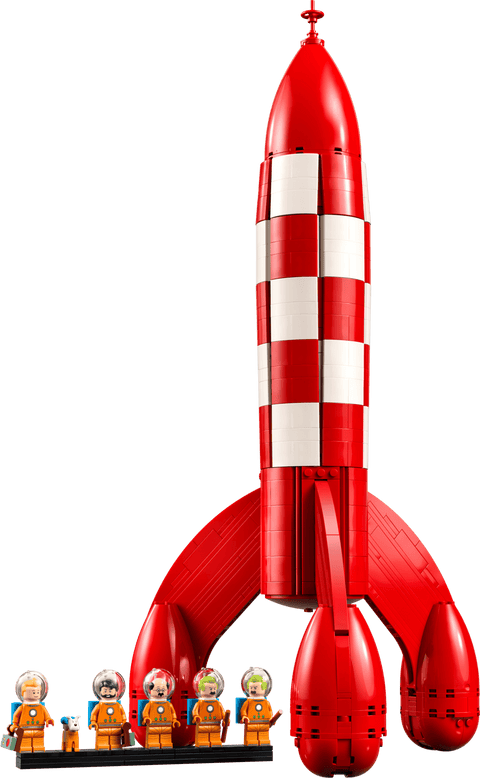
The official Tintin shop identifies the LEGO Ideas model as set 21367, with 1,283 pieces and an eighteen-plus recommendation. It measures approximately 49 centimeters high, 20 wide and 23 deep. Its red-and-white checkerboard exterior surrounds a removable panel revealing a control room. The named characters are Tintin, Captain Haddock, Professor Calculus, Thomson, Thompson and Snowy. Calling these six characters is clearer than assuming that every one uses the same figure format.
Those specifications make the catalog item a substantial vertical display rather than a pocket-sized rocket ornament. Measure the intended shelf before building and allow space above it for comfortable handling. Consider whether you want the control-room opening accessible or prefer an uninterrupted view of the exterior. The model’s identity should remain attached to its set number in your records, particularly when comparing it with other Tintin rockets. Similar subjects can be made in different materials and sizes without being interchangeable editions.
Why the checkerboard works in three dimensions
The red-and-white pattern offers a strong visual rhythm, while the tapering body directs attention upward. In a display, that combination can remain readable even when the viewer is too far away to inspect individual bricks. Look at the finished silhouette from the doorway as well as from your usual viewing position. If surrounding objects interrupt the outline, a little empty space may communicate the design more effectively than additional accessories.
The move from printed page to construction model also changes how the pattern is experienced. An illustration chooses one angle for the reader; a model invites the viewer to move around it. Comparing those experiences is a useful way to appreciate the adaptation without ranking one medium above the other. Photograph the model against a simple background, then compare that photograph with an album illustration you own. The exercise can reveal how viewpoint, lighting and surrounding space change an object that initially seems completely familiar.
Build a collection around the adventure
A Tintin lunar collection can remain coherent with only the two albums and one carefully chosen model. If you add another object, ask whether it contributes a different perspective: a character relationship, an illustration or a contrasting material. Repeating the rocket at several sizes may be satisfying, but it is a different collecting project from exploring the story’s cast. Define your project before using a broad franchise search to expand it.
Keep assembly instructions and separated components associated with the correct set. If the model is moved, document the arrangement before taking sections apart rather than relying on memory. For an opened example, compare the contents against the manufacturer’s instructions, not just a front-facing photograph. The enduring attraction here is the connection between reading and making. A thoughtful display can invite someone to discover the books while giving an existing reader a new way to examine a familiar journey.
FAQs
Which Tintin books inspired the LEGO Moon Rocket?
The official Tintin shop identifies Destination Moon and Explorers on the Moon as the model’s inspirations.
Is this a model of an actual historical lunar rocket?
It represents the rocket from Hergé’s fictional adventures. Read it as a literary and visual collectible rather than a technical replica of a real mission.
Sources
Pre-orders
Pre-orders are open
Reserve upcoming releases before they land. Full refund any time before it ships.