
The Collector’s Shelf
The Curse of La Llorona
Explore Thrilljoy’s Weeping Woman PIX!, the 2019 adaptation’s costume and effects, and the folklore beyond its particular screen design.

Pre-order: The Curse of La Llorona
All pre-orders →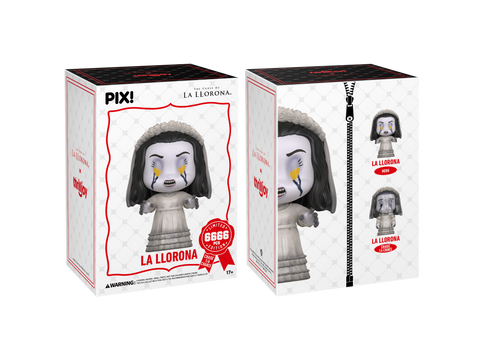
Explore Thrilljoy’s Weeping Woman PIX!, the 2019 adaptation’s costume and effects, and the folklore beyond its particular screen design.
A particular screen apparition
Mystery Collective’s catalog lists Thrilljoy PIX! La Llorona: The Weeping Woman under The Curse of La Llorona. Thrilljoy describes dark hair, yellow eyes, a pale face, streaked makeup, and a white gown and veil. It identifies a 6,666-piece edition. The combination follows the movie’s screen identity.
A contemporary film set in 1973
Warner Bros.’ press release places Anna Tate-Garcia, played by Linda Cardellini, in 1973 Los Angeles. The widowed social worker’s response to another family’s danger puts her own children at risk. The film marked Michael Chaves’s feature directing debut and was produced by James Wan, Gary Dauberman and Emile Gladstone. Its historical setting and its production history are separate dates.
The film’s horror context
The BBFC records a 2019 production year and describes strong horror with sustained threat. Its advice specifically mentions children being haunted and attacked. That context belongs to the source film even when a character is translated into a stylized collectible. A compact figure format does not change the original story’s tone.
Many stories share the name
Library of Congress folklorist Stephen Winick explains that La Llorona means the weeping woman, while appearances, actions and origins vary between accounts. Some stories describe pursuit, others a warning or a distant cry. Relationships with children also differ. His introduction discusses Bess Lomax Hawes’s work on stories circulating among young women in a California juvenile detention center in the 1960s. These records preserve how people told and understood the figure. They are evidence of a living storytelling tradition, not proof that the supernatural events occurred. The movie contributes an adaptation rather than replacing that variety.
A familiar house and a water-worn gown
The production notes describe Melanie Jones’s use of a two-story Victorian in Los Angeles’s West Adams district for Anna’s home. Golden oak and layers of family possessions helped it feel inhabited before the threat arrived. Early-1970s magazines, photographs and films informed its period details. Costume designer Megan Spatz combined references for La Llorona’s dress rather than fixing it to one fashion period. Jason deCaires Taylor’s underwater sculptures inspired its aged, water-worn appearance. The domestic setting and deteriorated costume establish different kinds of texture: accumulated family life on one side, an unsettling presence on the other.
Reflections and an actor beneath the makeup
Chaves told Monsters and Critics that dark phone screens helped the crew plan reflected images. Most reflections were captured in camera. The final shot used a mirror, altered into a puddle in post-production because real water did not give a sufficiently clear image. He also credited Marisol Ramirez’s performance: she originally auditioned for Patricia before he considered her for La Llorona. Eleanor Sabaduquia and Gage Munster developed the makeup with him. Digital augmentation assisted individual effects, but the apparition depended substantially on a performer beneath the design.
The soundtrack’s closing contrast
WaterTower Music released Joseph Bishara’s soundtrack on April 12, 2019. Its credits identify him as composer, conductor and album producer, with orchestration by Dana Niu and recording at the Eastwood Scoring Stage. The album ends with the traditional Arrorró Mi Niño, performed by Maria Lopez and produced by Bishara. A lullaby beside the original horror score gives the film’s concern with children a musical expression as well as a visual one.
FAQs
Does the movie define every version of La Llorona?
No. The Library of Congress introduction documents varied appearances, behavior and origins across different tellings.
Were all the reflections made with water?
No. Chaves described using a mirror for the final shot, then changing its appearance into a puddle in post-production.
Sources
- Thrilljoy PIX! La Llorona: The Weeping Woman
- Library of Congress introduction to La Llorona
- Warner Bros. UK home-entertainment press release
- BBFC The Curse of La Llorona
- The Curse of La Llorona production notes: filmmaking and design interviews
- Michael Chaves interview with Fred Topel, April 2019
- WaterTower Music soundtrack credits and release information
Pre-orders
Pre-orders are open
Reserve upcoming releases before they land. Full refund any time before it ships.