
The Collector’s Shelf
Sadako (Character)
Discover Sadako’s literary and film background, the Nendoroid rerelease and how its hair parts, well and television backdrop shape a horror display.
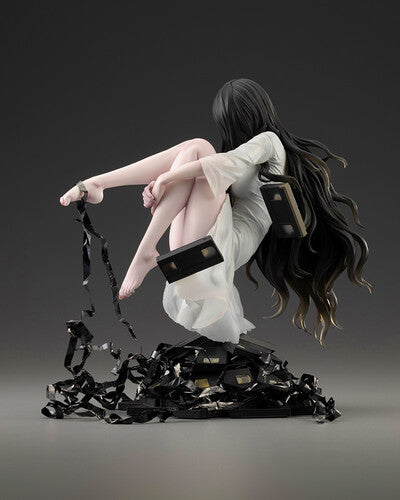
Pre-order: Sadako (Character)
All pre-orders →
Discover Sadako’s literary and film background, the Nendoroid rerelease and how its hair parts, well and television backdrop shape a horror display.
A horror character translated into a small scene
The catalog's Sadako Nendoroid rerelease is manufactured by Good Smile Arts Shanghai and sculpted by QingYu. Its interchangeable parts create compact horror scenes.
The story began in print before its famous film form
Japan's National Diet Library records Koji Suzuki's Ring as a Kadokawa Shoten publication from June 1991. The library's separate exhibition introduction describes Sadako Yamamura as the psychic figure whose grudge is projected onto a videotape in Suzuki's horror series. That places the character within a literary premise before considering the imagery that film audiences remember.
The library's account also identifies Sadako's mother, Shizuko, as a character with claimed clairvoyance and thoughtography abilities, and her father as a researcher disgraced over his investigations. The family background gives the curse a history within the fiction. A television or tape is not merely an ominous decorative object: it becomes a medium through which Sadako's resentment reaches other people.
Keep historical inspiration separate from supernatural fact
The National Diet Library's exhibition connects aspects of Ring's fictional family background with the early-twentieth-century controversy surrounding researcher Fukurai Tomokichi and claims of clairvoyance and thoughtography. It presents the experiments, scientific debate and public response as subjects of historical research. This is background to the fiction, not evidence that the story's curse or claimed paranormal abilities are real.
The exhibition dates the central controversy to 1910–11 and discusses Fukurai's 1913 book Toshi to Nensha, which recorded his account of the experiments. It also presents the objections of scientists who examined the procedures. The researchers did not all begin by rejecting the claims, but disagreements about controls, conditions and explanations became central. This documented dispute is more useful background than treating a horror story as proof of a real curse.
Thoughtography claimed to create images through mental action. Ring transforms that disputed idea into a fictional curse carried by recorded pictures.
The 1998 film established a powerful visual reference
Arrow's presentation of Ringu identifies Hideo Nakata as director of the 1998 Japanese film. Its synopsis centers on journalist Reiko investigating deaths associated with a videotape. This connects a domestic technology with a supernatural threat, a combination that helps explain why a television backdrop can carry so much meaning in a miniature display. The collector does not need a large setting for that contrast to be legible.
Arrow's 4K edition uses a restoration from the original camera negative and retains Japanese 5.1 and stereo soundtrack options. Its supporting material approaches the film from several directions: David Kalat provides commentary, Kat Ellinger discusses Nakata's career, Alexandra Heller-Nicholas examines the series' development, and Jasper Sharp considers J-horror. These are distinct critical contributions rather than a single making-of feature. They document how the film is presented and studied in a later home-video edition.
Hair and scenery do much of the storytelling
The articulated, non-scale painted-plastic figure is approximately 100 mm tall and includes a stand. Its grinning and vicious faces combine with three hair arrangements: a hidden face, an exposed eye or hair reaching the ground. Scene elements include a well, videotape and television-emergence background sheet. The television setting is flat scenery, not a complete three-dimensional TV model.
Compare the rerelease and its exact contents
Good Smile's US listing separately identifies a TV Static background as a shop bonus. That extra should not be assumed to accompany another seller's copy; distinguish it from the standard television sheet.
FAQs
Is the television accessory a full miniature TV?
The standard product description specifies a background sheet for the television scene. Compare the exact listing contents before expecting a freestanding television prop.
Does the figure belong to a specific movie-year edition?
The official listing identifies Sadako as a character. This guide uses the novels and 1998 film for context without assigning the Nendoroid to a particular film edition that the manufacturer has not specified.
Sources
Pre-orders
Pre-orders are open
Reserve upcoming releases before they land. Full refund any time before it ships.