
The Collector’s Shelf
Rocketeer
Explore Dave Stevens’ Rocketeer, Cliff Secord’s aviation roots and the comic-to-film history behind the 2026 SDCC art-card release.

 Cards
Saturday Morning Cards SMC 2024 The Rocketeer Sealed Box Pack
Saturday Morning Cards
$109.99In stock Cards
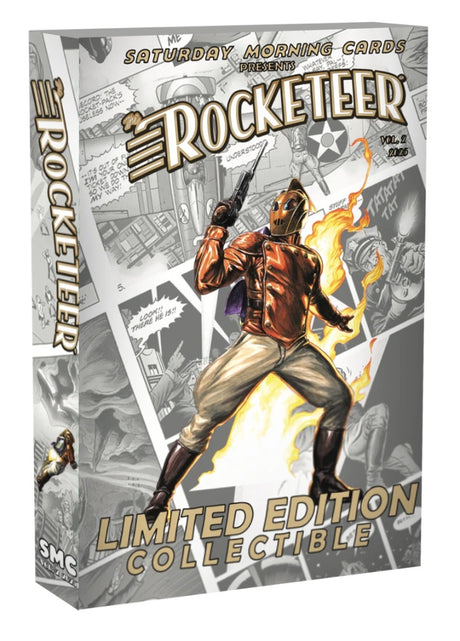
Saturday Morning Cards Rocketeer Vol. 2 Limited Edition Box 2025 Factory Sealed
Saturday Morning Cards
$79.99In stock Cards
Saturday Morning Cards The Rocketeer Red LA Comic Con Exclusive Limited Edition Box #28/50
Saturday Morning Cards
$207.99In stockExplore Dave Stevens’ Rocketeer, Cliff Secord’s aviation roots and the comic-to-film history behind the 2026 SDCC art-card release.
A modern comic looking back toward pulp adventure
Dave Stevens introduced The Rocketeer in 1982. His official biography describes the feature beginning as a backup in an independent comic and identifies its hero as stunt pilot Cliff Secord, who discovers an experimental rocket pack. Stevens had already worked on the Tarzan newspaper strip and in storyboarding. The character’s historical atmosphere should therefore be separated from its publication date: this is a later artist imagining an earlier adventure world.
The catalog's 2026 SDCC Exclusive Rocketeer comes from Saturday Morning Cards, whose Rocketeer range explicitly references Stevens' comic-book hero. The starting point is therefore the comic, even for someone who first encountered Cliff through the later film.
The official biography names two especially useful examples of Stevens' storyboard work: Raiders of the Lost Ark and Michael Jackson's Thriller. Those credits place his comics alongside work concerned with staging action for a camera. They do not make The Rocketeer part of either production, but they help explain why discussing the artist's career means looking beyond comic-book publication alone. IDW places the first Rocketeer backup at Pacific Comics in April 1982.
Cliff’s enthusiasm gives the rocket its human scale
The backstory on the Dave Stevens website portrays Cliff as fascinated by air racing and the compact Gee Bee aircraft. It describes his work around airfields, his relationship with mechanic Peevy and their eventual move toward Hollywood stunt work. The rocket pack enters a life already shaped by flying, improvisation and uncertain employment. It is not simply a magical object handed to someone with no previous connection to the sky.
In the official fictional backstory, the turning point is Cliff seeing the 1931 All American Flying Derby. His later acquisition of the damaged Gee Bee Z leads to a lengthy rebuild with Peevy; the restored aircraft is nicknamed the Blind Bulldog. These details make his ambition dependent on patient mechanical work as well as risk-taking. They are elements of Cliff's invented biography, not a substitute for a historical account of the aircraft or its real pilots.
Original-art presentation reveals the work behind the image
IDW identifies The Rocketeer as the inaugural release in its Artist’s Edition series in 2010. Its later anniversary edition reproduces scans of original artwork, retaining details such as blue-pencil marks, corrections and variations in ink. That format makes a different promise from a normal reading copy: it invites the viewer to examine how the page was made. The documented milestone is a publishing treatment of Stevens’ art, not an award claim for the catalog card.
The Artist's Edition makes revisions and working marks visible. A finished art card does the opposite: it condenses attention onto a selected image. Those formats offer complementary views of Stevens' drawing, one exposing the page's manufacture and the other emphasizing its finished composition.
The 1991 film is a distinct adaptation milestone
Disney’s D23 archive dates The Rocketeer film to June 21, 1991 and credits Joe Johnston as director. Its account places Cliff and Peevy in 1938 and identifies Jenny Blake as Cliff’s actress girlfriend. The cast includes Bill Campbell, Jennifer Connelly, Alan Arkin and Timothy Dalton. These details describe a particular screen adaptation of Stevens’ character, not the original date or full identity of the comic.
The comic backstory calls Cliff's girlfriend Betty; the film uses Jenny. That concrete change is a useful marker of adaptation. A card described as comic art should not acquire Jennifer Connelly's likeness or a film-scene identification merely because the movie is familiar.
D23 also identifies practical decisions behind the film's period setting. Airport scenes were made in Santa Maria, California, with an airport constructed to suggest Los Angeles in 1938. The Bulldog Cafe drew on an actual Los Angeles restaurant from the 1920s. The adaptation's historical atmosphere was therefore created through selected locations and built environments, not simply by placing the rocket helmet in front of an old-fashioned background.
A convention title is one part of identification
Saturday Morning Cards lists the exact 2026 SDCC Exclusive Rocketeer release separately from Rocketeer Vol. 2 and a Dave Stevens collectors set described as a four-card box. Those neighboring titles establish that the maker offers more than one configuration. They do not establish that the 2026 item has the same number of cards, artwork or packaging as a differently named set.
The captured 2026 product text confirms its title but does not establish card count or artist. The separately listed four-card set cannot resolve those gaps.
FAQs
Did The Rocketeer originate with the 1991 movie?
No. Dave Stevens introduced the comic feature in 1982; the film followed in 1991.
Is the 2026 SDCC card the same as the four-card collectors set?
They are separately named manufacturer listings. Do not transfer the four-card contents to the 2026 release without explicit confirmation.
Sources
Pre-orders
Pre-orders are open
Reserve upcoming releases before they land. Full refund any time before it ships.