
The Collector’s Shelf
Reality Fracture
Explore Reality Fracture’s alternate Magic worlds, mirrored characters, and connected artwork, with precise distinctions between the set and neighboring catalog products.

Pre-order: Reality Fracture
All pre-orders → Pre-order
Magic: The Gathering Reality Fracture Secret Lair Bundle
Wizards of the Coast
 Pre-order
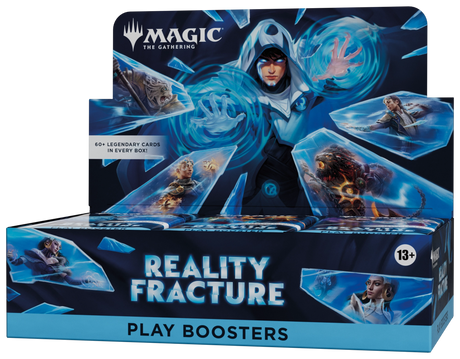
Magic: The Gathering Reality Fracture Play Booster Box
Wizards of the Coast
 Pre-order
Magic: The Gathering Reality Fracture Multiverse Reforged Commander Deck
Wizards of the Coast
 Pre-order
Magic: The Gathering Reality Fracture Draft Night
Wizards of the Coast
 Pre-order
Magic: The Gathering Reality Fracture Bundle
Wizards of the Coast
Explore Reality Fracture’s alternate Magic worlds, mirrored characters, and connected artwork, with precise distinctions between the set and neighboring catalog products.
An alternate reality with an identifiable author
Reality Fracture is a Magic: The Gathering setting and set centered on Jace Beleren's attempt to replace a damaged Multiverse with a reality of his own design. Its official tabletop release date was October 2, 2026, placing it before this page's November review. The story's alternate world is called the Echoverse. It is not simply a collection of unrelated alternate costumes: the premise asks what familiar histories become when formative events and threats are removed.
That makes the theme especially suited to comparison. A card can be interesting because of its relationship to an earlier character, place, or visual idea. For a focused collection, begin with one such relationship and record what is actually confirmed about it. The aim is to understand a deliberate reinterpretation, not to assume that every changed color, name, or costume signals the same kind of narrative change.
Separate Jace’s portrayals rather than flattening them
The official legends article distinguishes Jace, Reality Sculptor; Jace, Multiverse Architect; and The Theorist, Jace Beleren. Its account connects the project with his response to loss and the Phyrexian Invasion, while explaining that the Theorist is a fractured aspect that has suppressed qualities such as empathy and wisdom. The names therefore carry narrative differences even though all relate to Jace.
A character-led binder could put those portrayals in conversation with one another. Record the exact printed name and the corresponding official biography, then add your own observations about gesture, expression, and composition. Do not reduce the comparison to a claim that one card is the definitive version of the character. Nor should a more elaborate frame be mistaken for a separate fictional identity when the underlying card is unchanged. The relationship between character, card design, and treatment is part of the subject.
Hexhaven turns familiar academic imagery toward control
The Planeswalker's Guide presents Hexhaven Academy as a regimented magical institution in Echoverse Arcavios. Its cadets train as battlemages in a setting shaped by danger, discipline, and the Theorist's influence. The same guide describes surveillance imagery and creatures distorted by unstable reality. Those details provide a concrete visual vocabulary for reading the set rather than treating every strange image as an isolated monster design.
For an environment-focused collection, look for confirmed cards that show architecture, uniforms, or altered creatures. Compare how the scene directs attention: toward an authority figure, a controlled space, or a body that no longer appears stable. These are interpretive questions for the actual artwork, not additional lore claims. Keep the official account nearby when identifying a location, and leave an uncertain background unnamed rather than assigning every tower or classroom to the same place.
The artwork can show both the reference and the change
Wizards describes shattered mirror cards as combining a new version with the artwork that inspired it. The collecting guide also identifies a ten-card Special Guests panorama illustrated by Marina Banker, designed so the sequence can continue around rather than requiring one fixed central card. These are two different ways of making the Echoverse visible: comparison within an image and continuity across several images.
Both invite a deliberate display arrangement. A mirrored-card project can document the original reference and the altered presentation. A panorama project needs attention to order and adjoining edges. Before making either a completion goal, check the precise card list and treatment. A connected artistic concept does not guarantee all its pieces appear in one package, and a foil finish should not be used as a substitute for identifying the underlying image. Keep artist credits with each card rather than attributing an entire set to one contributor.
Keep the set’s products separate from nearby Foundations decks
The selection includes Reality Fracture Play Booster Box, Collector Booster Box, Bundle, Draft Night, Prerelease Pack, Secret Lair Bundle, and Multiverse Reforged Commander Deck. These are distinct named products within the browsing group. The official collecting guide identifies the Secret Lair Bundle as a new product approach combining boosters with specially presented promo cards, so its name should not be shortened to an ordinary Bundle when comparing contents.
The same local theme grouping also contains Calling All Angels, Keen Engineering, Reign of Dragons, Tramplesaurus Rex, and Wretched Ranks Foundations Commander Decks. Their titles explicitly identify Foundations. Treat them as neighboring catalog entries, not evidence that their stories or illustrations belong to Reality Fracture. For a collection specifically about the Echoverse, verify the set and card identity before including material simply because it appears in the same browsing category.
Follow the story without inventing a single required collection
The official world guide and legends reference serve different purposes. One establishes the setting and its tensions; the other helps distinguish named characters and their counterparts. Reading them alongside actual card images is more reliable than inferring a whole biography from a dramatic title. It also leaves space to enjoy the art without needing to acquire every treatment or every related Magic release.
Choose a bounded project, such as one character's confirmed portrayals, a small group of mirrored designs, or a scene assembled from its actual components. Keep a note of which claims come from published lore and which are your own reading. Relevant updates or guides may clarify a card's relationship to earlier material, but a speculative fan connection should remain speculative. The resulting collection can explain why a design matters without making promises about future importance, demand, or market value.
FAQs
Are the Foundations Commander decks part of the Reality Fracture story?
Their presence in the local browsing group does not establish that. The five entries explicitly say Foundations Commander Deck. Keep their product identity separate and verify individual cards before treating them as Echoverse material. Catalog proximity is not a narrative connection.
Does a different frame mean a different version of a character?
Not necessarily. Distinguish the printed card identity from its visual treatment. The official legends guide explains named portrayals, while the collecting guide describes presentation variants. Use both when comparing cards so a cosmetic change is not mistaken for a new biography.
Sources
Pre-orders
Pre-orders are open
Reserve upcoming releases before they land. Full refund any time before it ships.