
The Collector’s Shelf
Kellogg’s
Discover Kellogg’s advertising-character heritage, Tony the Tiger’s visual evolution and the Thrilljoy 2026 Summer Event collectible.
Pre-order: Kellogg’s
All pre-orders →
Discover Kellogg’s advertising-character heritage, Tony the Tiger’s visual evolution and the Thrilljoy 2026 Summer Event collectible.
A food-company name becomes a collecting theme
Kellogg's has a history broader than any single mascot. WK Kellogg's timeline traces the business to W.K. Kellogg's establishment of the Battle Creek Toasted Corn Flake Company in 1906. For a collectibles page, that is the starting point of an advertising and packaging tradition, not the founding date of a toy manufacturer. Mystery Collective's Kellogg’s theme currently points to a Thrilljoy interpretation of Tony the Tiger, so the relevant connection is character design rather than cereal production.
That distinction helps make the page useful to different visitors. Someone interested in advertising history may want to understand how a familiar commercial image became a display object. Someone who remembers Tony from childhood may care more about the expression and pose. Both interests can coexist without treating every Kellogg's-branded object as the same kind of artifact. Identify the company heritage, the specific cereal character and the modern collectible maker as separate layers.
Tony the Tiger’s identity begins with Frosted Flakes
The official Frosted Flakes history places Tony's introduction in 1952 and describes a character whose personality developed around encouragement and confidence. Its historical presentation also records a competition with another prospective mascot. Tony therefore belongs specifically to Frosted Flakes within the wider Kellogg's family; he is not an interchangeable mascot for every cereal carrying the company name.
For a collector, the interesting feature is the balance between animal identity and human gesture. Stripes establish the tiger immediately, while the friendly face and body language make him an approachable spokesperson. A good character display can emphasize that combination without reproducing a full advertisement. Consider whether the version you prefer communicates enthusiasm, reassurance or humor. Those qualities explain personal attachment more clearly than broad claims that every viewer must remember the same commercial or share the same nostalgic response.
Retro packaging makes visual change part of the story
In April 2023, Kellogg Canada announced a limited-period retro packaging program for Frosted Flakes, Froot Loops, Rice Krispies and Corn Flakes. Its Frosted Flakes treatment drew on 1970s and 1980s design elements, including a flatter illustration of Tony with a cereal bowl. The same announcement described mascot-themed flying discs as a separate promotion. These are historical examples of packaging and promotional objects, not offers that should be assumed to remain available.
The program is useful context because it treats earlier graphics as something worth revisiting. A contemporary figure can sit beside that history while doing something different: adding depth, changing proportions and selecting a pose that reads from several angles. When comparing an old illustration with a new sculpt, look for continuity in the recognizable cues, then notice what the new format changes. A modern object can be an affectionate reinterpretation without being described as an exact reproduction of a decades-old drawing.
The 2026 Summer Event figure keeps breakfast in the scene
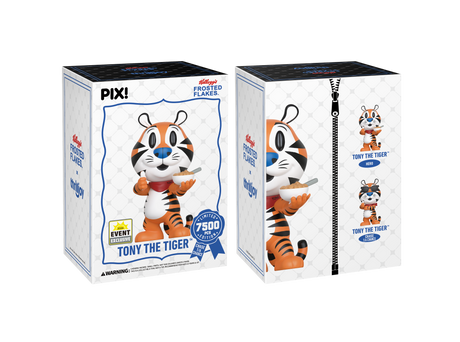
The catalog's precise item is PIX! Tony the Tiger: 2026 Summer Event by Thrilljoy. Its official description presents Tony with orange-and-black stripes, a blue nose and red bandana, offering a thumbs-up while holding a bowl of frosted flakes. The manufacturer states a 7,500-piece run and a collector card serving as a certificate of authenticity. These details identify a specific release rather than a general promise about every Tony figure.
The bowl is an especially useful design choice: it preserves the link to the character's advertising role while the gesture communicates personality. In an arrangement, make sure both remain visible. Do not turn the year and event wording into an unsupported claim that a particular copy was bought at a named convention. The title belongs to the product; an individual object's purchase history requires separate evidence. Likewise, treat the sculpted bowl as part of the design unless detachable functionality is explicitly documented.
Mascot collecting can connect several kinds of design
Tony's official history describes a character extending into digital and social media as well as the Mission Tiger initiative. That continued use illustrates a direction beyond simply repeating old packaging. Meanwhile, the catalog figure translates a recognizable commercial personality into a modern collectible format. The two developments share a character, but they are not evidence that buying the figure participates in a campaign or includes any digital benefit.
A thoughtful Kellogg's display can be organized by visual medium rather than by trying to obtain everything. For example, separate printed artwork from sculptural interpretations, or compare how a familiar gesture works in a flat image and in a rounded object. Keep any personal memory attached to your own experience: the box you remember, the commercial you watched, or the artwork that first caught your attention. That approach creates a meaningful collection without requiring unsupported claims about universal popularity or collector appeal.
Preserve the edition and the advertising context together
When recording this Tony piece, retain the complete 2026 Summer Event title and Thrilljoy attribution. Keep the cereal association alongside them so a future viewer can understand why a tiger is holding a breakfast bowl. A short note can explain the relationship more effectively than a crowded display of unrelated logos. The broader Kellogg's theme is useful context, but the specific character remains the center of this catalog entry.
Inspect the actual copy rather than assuming every photograph shows the same treatment. If a listing includes variant imagery, establish which appearance is being offered before deciding how it fits your display. Store the card and packaging with the correct item, and distinguish printed edition information from a handwritten purchase note. For photographs, reduce reflections on the window so the face and bandana remain readable. These small documentation choices preserve both the collectible's identity and the advertising character that makes it interesting.
FAQs
Does Kellogg’s name identify the manufacturer of this figure?
No. The catalog names Thrilljoy as the maker of PIX! Tony the Tiger: 2026 Summer Event. Kellogg’s is the theme, and Tony is associated with Frosted Flakes.
Does “2026 Summer Event” prove a copy came from a particular convention?
No. It is the documented release title. A specific copy’s convention purchase history would need separate provenance; the title alone does not establish it.
Sources
Pre-orders
Pre-orders are open
Reserve upcoming releases before they land. Full refund any time before it ships.