
The Collector’s Shelf
Junji Ito
Explore PIX! Tomie through Junji Ito’s creative process, drawing techniques, and the publishing and exhibition history of his horror art.
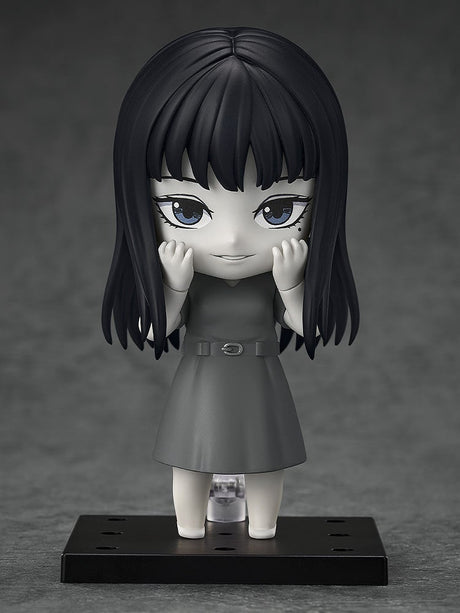

Pre-order: Junji Ito
All pre-orders →

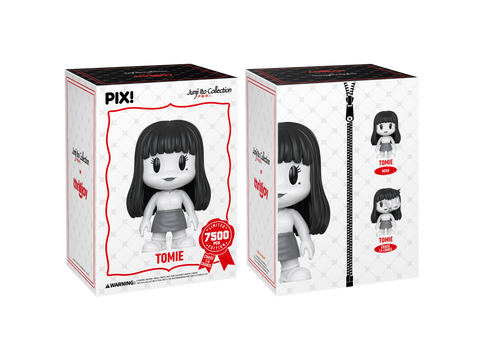
Explore PIX! Tomie through Junji Ito’s creative process, drawing techniques, and the publishing and exhibition history of his horror art.
An artist’s name connects different kinds of horror
Junji Ito writes and draws horror that gives ordinary bodies, places, and objects impossible new rules. Tomie returns after death; Uzumaki turns the spiral into a consuming threat; Gyo imagines walking fish corpses. Those distinct premises belong to an artist’s body of work. Mystery Collective’s example is Thrilljoy’s PIX! Tomie, a character portrait that leads back to one of his earliest creations.
VIZ dates Ito’s professional manga debut to 1987 and identifies Tomie as his debut work. His career spans extended stories and short-story collections, including Shiver, Smashed, and The Liminal Zone. On July 25, 2025, he entered the Will Eisner Comic Awards Hall of Fame at San Diego Comic-Con. His range also extends across adaptations: the Netflix anthology Maniac: Japanese Tales of the Macabre draws on short stories, while Uzumaki became an animated miniseries. The creator’s name connects these forms without making their individual premises interchangeable.
The personal idea behind Tomie’s return
In an interview published by Mamegyorai, Ito traced Tomie’s starting point to a classmate’s sudden death when he was in junior high school. He remembered the unreal feeling that the person might simply appear again as though nothing had happened. That unsettling mismatch between knowing someone has died and expecting their return supplied an emotional seed for the manga’s impossible recurrence.
A second impulse concerned drawing beauty. Ito recalled studying faces in fashion magazines while considering how to create an exceptionally beautiful face. He pays particular attention to eyes and eyelids, but described the face as a relationship between parts: eye placement, nose, mouth, outline, and the size and position of the beauty mark. This makes Tomie’s identity more precise than a general long-haired silhouette. Her recognition depends on carefully balanced features, even before the story reveals what lies behind them.
One face, many unsettling stories
VIZ’s description introduces Tomie Kawakami through her long dark hair, the beauty mark beneath her left eye, and the destructive obsession she provokes. Men are drawn toward her, violence follows, and killing her never resolves the threat. The contradiction is central: the person who appears vulnerable to violence also defeats the finality that violence normally implies. A composed face can therefore be disturbing without a visibly monstrous costume.
Editor Masumi Washington described VIZ’s 752-page deluxe hardcover as a collection of twenty Tomie short stories. That structure gives the recurring character room to change circumstances and appearances instead of relying on one sustained pursuit. Washington also connected Ito’s treatment of Tomie with the repeated spiral images in Uzumaki and fish in Gyo: an image becomes an engine for invention. In Tomie, beauty itself can become grotesque, so a familiar portrait carries the possibility of a radically unfamiliar next image.
What the black-and-white PIX! design emphasizes
Thrilljoy’s PIX! Tomie translates that recognition into a black-and-white collectible. The maker identifies her long hair, button-up blouse, skirt, smile, and beauty mark beneath the left eye. It lists a production run of 7,500 pieces and a collector’s card serving as the certificate of authenticity. These are the documented features of the specific Thrilljoy release represented here.
The restrained palette makes the face and hair the strongest visual anchors. Dark hair frames the lighter face, while the small facial mark gives an otherwise simplified portrait a highly specific identity. The blouse and skirt keep her outward appearance ordinary. Knowledge of the manga makes that ordinariness unsettling: menace inhabits a familiar face instead of announcing itself through a monstrous costume.
From inexpensive paper to deliberately rough digital lines
Ito’s 2021 conversation with fellow artist Akiko Hatsu offers a practical account of how his style developed. He was still working as a dental technician when Tomie brought him his debut, and continued both occupations for a time. Earlier attempts at inking had stalled halfway through; Tomie was the first manga he finished in ink, using inexpensive paper bought locally.
He remembered the early Tomie drawings as simpler than his later work, with empty space contributing to the design. That is a useful counterpoint to his reputation for dense detail: the balance between marked and unmarked paper has also been part of his visual language. By the interview, a hand injury had led him to switch to CLIP STUDIO PAINT. He adjusted digital lines to retain a rough, traditionally drawn quality rather than making them uniformly clean. The change of tool did not mean abandoning the texture he wanted on the page.
Seeing the artwork beyond the story sequence
The Art of Junji Ito: Twisted Visions gives readers another way to examine those decisions. VIZ’s 2020 art book gathers more than 130 images, including rare work and both monochrome and color illustrations. Its artist commentary and technique interview shift attention toward how individual images are made. A story encourages the reader to turn the page; an art collection invites a longer look at the arrangement of faces, bodies, textures, and surrounding space.
That approach also informed Junji Ito Exhibition: Enchantment at Tokyo’s Setagaya Literary Museum, held from April 27 to September 1, 2024. The museum presented original manga drawings, illustrations, paintings, and newly created work. Its selection included Tomie, Uzumaki, Lovesickness, Souichi, and The Hanging Balloons. Seeing these titles together places the recurring Tomie face within a larger practice of visual invention. It also broadens the meaning of an Ito-themed collection from a single horror character to the drawing choices behind many different kinds of fear.
FAQs
Is Tomie one continuous long-form story?
VIZ’s Complete Deluxe Edition gathers twenty Tomie short stories in a 752-page volume. The recurring character connects those stories, while their changing situations let Ito revisit beauty, obsession, and return from different angles. The English deluxe edition was released on December 20, 2016.
Is Junji Ito’s artwork always black and white?
No. Twisted Visions includes both black-and-white and color illustrations. The monochrome appearance of Thrilljoy’s PIX! Tomie is a choice for that collectible, while Ito’s illustration work uses a broader range of approaches.
Sources
- Thrilljoy PIX! Tomie
- VIZ Tomie: Complete Deluxe Edition
- VIZ Junji Ito Hall of Fame announcement
- Junji Ito interview on Tomie’s origins and facial design
- Junji Ito and Akiko Hatsu discuss horror-manga technique
- VIZ editor Masumi Washington on Tomie and Ito’s art
- VIZ The Art of Junji Ito: Twisted Visions
- Setagaya Literary Museum: Junji Ito Exhibition Enchantment
Pre-orders
Pre-orders are open
Reserve upcoming releases before they land. Full refund any time before it ships.