
Collection
Harlem Globetrotters Collectibles & collecting guide
Pre-order: Harlem Globetrotters
All pre-orders →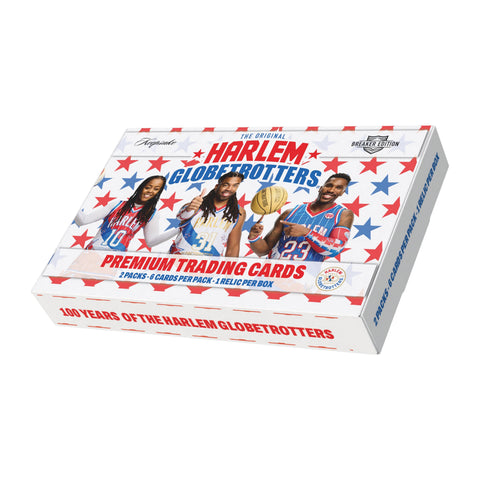

Discover Harlem Globetrotters history, basketball showmanship and the catalog’s centenary card formats, with clear distinctions between team milestones and anniversary packaging.
A basketball story behind the spectacle
The Harlem Globetrotters combine athletic performance with entertainment, but their history should not be reduced to comedy alone. The Naismith Basketball Hall of Fame traces their roots to players from Chicago’s Wendell Phillips High School and documents the early team’s progression into professional basketball. It also records their victory in the 1940 World Professional Basketball Tournament. That competitive background gives historical context to a name now associated with elaborate ball handling and audience participation.
For collectors, this creates two related subjects: the team as a sporting institution and the team as a traveling performance. A collection can acknowledge both without forcing every image into a conventional league-statistics framework. Ask whether an item documents a player, a particular event, an entertainment persona, or an artistic celebration. The answer helps determine which information belongs on a display label and prevents a visually striking card from being mistaken for a record of an actual game.
Why the anniversary is dated 2026
The team’s own timeline begins in 1926 and places its first road game in Hinckley, Illinois, on January 7, 1927. Those dates refer to different milestones, which is why a 2026 centenary title can coexist with a 1927 first-game reference. The same timeline records victories over the Minneapolis Lakers in 1948 and 1949, an international tour in 1950, and Wilt Chamberlain’s season with the team in 1958–59. These are useful anchors for understanding the breadth of the anniversary.
Rather than compressing a century into one undifferentiated nostalgia theme, consider choosing a few clearly labeled periods. An early-history note, a touring-era reference, and a contemporary player image can make a compact display readable. Leave room for the dates to explain themselves. An anniversary design commemorates elapsed history; it does not mean that every person pictured belonged to the original roster or that every piece of memorabilia dates to the founding year.
Showmanship as part of basketball culture
The Basketball Hall of Fame enshrined the Globetrotters in 2002. Its account highlights performers including Goose Tatum, Marques Haynes, Curly Neal, and Meadowlark Lemon, and notes the adoption of Sweet Georgia Brown as the team’s signature song in 1952. This institutional recognition offers a concrete measure of lasting cultural importance without needing to repeat promotional claims about being the best or most popular team in the world.
A still image cannot reproduce the rhythm of a passing routine or the timing of a joke, so a card collection inevitably selects fragments of a live experience. That limitation can become a useful curatorial idea. Group images by movement, expression, and interaction, then use short notes to connect them to what you remember watching. Keep personal memories clearly personal. A recollection of seeing a show can enrich a collection without becoming an unsupported claim about the pictured player or event.
Two formats for the centenary theme
The catalog includes 2026 Harlem Globetrotters 100th Anniversary Keepsake Premiere Breaker Box and 2026 Harlem Globetrotters 100th Anniversary Keepsake Premiere Breaker 10 Box Case. These exact titles identify the anniversary release and distinguish the single-box format from the case. They do not establish which players or insert designs any individual purchase will contain. The historical examples discussed here provide background for the team, not a guaranteed checklist of cards inside those packages.
A sensible collection plan starts with the part of the Globetrotters story that matters to you. A family who attended a show may favor a contemporary performer; a basketball-history reader may favor documented milestones; a design collector may prefer imaginative compositions. Write down that priority before comparing package sizes. It is easier to recognize a satisfying addition when the goal is a meaningful visual connection rather than simply more sealed material carrying the same anniversary logo.
Build an anniversary display with clear boundaries
Keep a brief timeline beside the cards, but avoid using a complete team chronology as decoration when only a few dates explain the display. Separate the date of a depicted event from the date of the card’s manufacture. If a card contains material described as a relic, preserve the exact statement about its origin with the card instead of replacing it with a broader description such as historic game jersey. Specific provenance language matters more than a dramatic summary.
For a collection shared with younger viewers, a small question can invite closer looking: does this image show basketball skill, performance, or an imagined scenario? That encourages engagement without requiring knowledge of every player. Store any accompanying paperwork with the item record, and document both sides of a card before putting it behind a frame. The result can celebrate a century of entertainment while remaining precise about what each object actually represents.
FAQs
Why does the centenary say 2026 if a first game was in 1927?
The official team history distinguishes its 1926 founding milestone from the January 1927 first road game. The anniversary title follows the former; the dates should not be presented as competing versions of the same event.
Sources
Pre-orders
Pre-orders are open
Reserve upcoming releases before they land. Full refund any time before it ships.