
Collection
Funko Collectibles & collecting guide
Pre-order: Funko
All pre-orders → Pre-order
Lilo & Stitch Plants Premium Funko Pop! Vinyl Figure #1798
Funko
Releases Estimated November 2026
 Pre-order
Hunger Games Haymitch Abernathy Funko Pop! Vinyl Figure #2116
Funko
Releases Estimated April 2027
 Pre-order
Marvel Weapon X Program Weapon X Premium Funko Pop! Vinyl Figure
Funko
Releases Estimated April 2027
 Pre-order
Ghost Face (Bling Mask) Glitter Funko Pop! Vinyl Figure #2168
Funko
Releases Estimated April 2027
 Pre-order
Scream 2022 Dewey Riley Funko Pop! Vinyl Figure #2171
Funko
Releases Estimated December 2026
 Pre-order
Avengers: Doomsday Gambit Funko Pop! Vinyl Figure
Funko
Releases Estimated December 2026
 Pre-order
Hunger Games Katniss Everdeen Wedding Dress Funko Pop! Vinyl Figure #2117
Funko
Releases Estimated April 2027
 Pre-order
One Piece Elbaph Usopp Funko Pop! Vinyl Figure
Funko
Releases Estimated November 2026
 Pre-order
Disney's Flubber with Glasses Translucent Funko Pop! Vinyl Figure #1834
Funko
Releases Estimated December 2026
 Pre-order
Masters of the Universe Vintage Teela Funko Pop! Vinyl Figure #64
Funko
Releases Estimated April 2027
 Pre-order
Marvel Comics Funko Pop! Mystery Keychain (One Random Keychain)
Funko
 Pre-order
Disney Readers Olaf with Book Funko Pop! Vinyl Figure
Funko
Releases Estimated December 2026
 Pre-order
The Hobbit Smaug Metallic Deluxe Funko Pop! Vinyl Figure #2188
Funko
Releases Estimated December 2026
 Pre-order
The Nightmare Before Christmas Funko Pop! Mystery Keychain (One Random Keychain)
Funko
 Pre-order
Poppy Playtime The Doctor Funko Pop! Vinyl Figure
Funko
Releases Estimated November 2026
 Pre-order
The Nightmare Before Christmas Valentine Funko Bitty Pop! Heart (One Random Figure)
Funko
 Pre-order
Lilo & Stitch Funko Pop! Mystery Keychain (One Random Keychain)
Funko
 Pre-order
Hello Kitty and Friends Valentine Funko Bitty Pop! Heart (One Random Figure)
Funko
 Pre-order
The Nightmare Before Christmas Funko Bitty Pop! Heart (One Random Figure)
Funko
 Pre-order
KPop Demon Hunters Funko Bitty Pop! Mystery Single (One Random Figure)
Funko
 Pre-order
One Piece Elbaph Zoro Funko Pop! Vinyl Figure Shelf Sitter
Funko
Releases Estimated April 2027
 Pre-order
Hello Kitty and Friends Lunar New Year Funko Bitty Pop! Mystery Single (One Random Figure)
Funko
 Pre-order
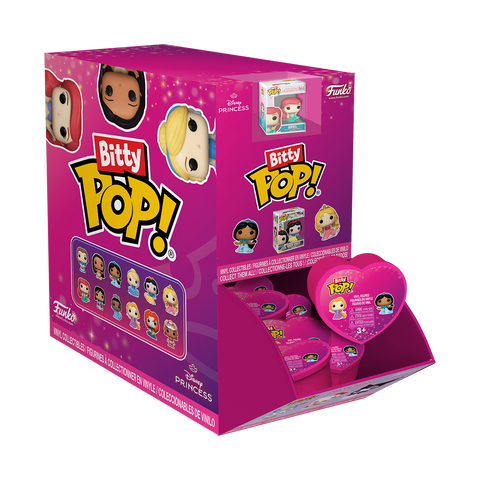
Disney Princess Funko Bitty Pop! Heart (One Random Figure)
Funko
 Pre-order
Star Wars Funko Pop! Mystery Keychain (One Random Keychain)
Funko
Pre-order
Scream 2022 Dewey Riley Funko Pop! Vinyl Figure #2171
Funko
Releases Estimated December 2026
Discover Funko history, Pop! and Bitty Pop! formats, variant terminology and practical collecting advice with related catalog items.
One visual language, many fandoms
Founded in 1998, Funko brings characters from many fictional worlds into shared collectible formats. Its product family includes Pop!, miniature Bitty Pop! and personalized Pop! Yourself figures. A display can therefore follow a cast across one format or compare how the same character changes with scale and finish.
The convention debut behind Pop!
Funko's own account places the first four figures associated with Pop! at San Diego Comic-Con in 2010. They were initially called Funko Force 2.0. The group featured Batman in blue and metallic blue, black-suit Batgirl and a glow-in-the-dark Green Lantern. Their early plastic-dome packaging differs from the familiar window-box presentation. According to Funko, remaining figures were repackaged into Pop! boxes after the convention.
The two Batman colors and Green Lantern's luminous treatment show that variants were present at the debut, rather than being a later addition to Pop! collecting. The change from plastic domes to window boxes also makes packaging part of this early history.
Understand size and finish before comparing
Funko's glossary places standard Pop! figures at approximately four inches tall on average, with differences by character. Size and finish are separate characteristics. Flocked figures have a fuzzy surface, metallic versions use metallic-looking paint, and glow-in-the-dark treatments change how a figure appears in darkness.
Blacklight decoration depends on a black light; it is not the same effect as glow-in-the-dark decoration.
From prototype to finished color
Funko's production terminology makes the development process easier to understand. A prototype tests a figure's mold and can reveal details that need correction before production. These test pieces often use only one or two vinyl colors. A hand-painted sample comes after mold approval and tests the intended color scheme. Shape and decoration are therefore separate development decisions, even when the finished figure presents them as one character.
Before the sculpt: licensing and concept decisions
In a March 2024 interview published by Funko, creative-development director Gary Ham describes a process that starts before anyone sculpts the figure. Merchandising and licensing teams determine which properties and characters can be developed, then establish a line list. A concept artist turns the selected character or scene into a design. The licensor approves that concept before the sculpting team develops its three-dimensional form. Color planning, rendering and packaging follow, with further revisions and approvals throughout.
Ham also identifies a substantial technical change: early Pop! figures were hand-sculpted, whereas sculpting is entirely digital in his 2024 account. He notes that planning licenses, release dates and retail partners can take years. A fan suggestion is therefore a starting point for development, not evidence of an announced or imminent release.
Balance, materials and decoration shape the result
Funko's sculptors explain that a character's proportions must work both within its fictional world and inside the intended packaging. Engineers determine how the parts can be molded and assembled. Material choice matters: a rigid plastic can be damaged when a projecting detail catches in a mold, while a softer material may flex during removal. The finished shape reflects those manufacturing constraints as well as the initial drawing.
Balance is another design problem. Sculptor Carla Peña describes placing feet beneath the head's center of gravity and sometimes reducing the depth of a hair-heavy head; some figures need bases. Decoration also involves different techniques. Funko describes stamping fine details onto smooth areas and spraying larger or heavily sculpted surfaces through masks. A collector comparing two releases can consequently examine silhouette, stance and paint placement as separate design decisions.
A specific example: the 2019 Sith Trooper
Lucasfilm's account of a 2019 San Diego Comic-Con panel shows how that process works with a tightly controlled film design. Funko's team received the character references needed for a collectible without learning the entire upcoming story. Lucasfilm could then advise on pose and characterization. Digital sculpting allowed reusable elements, such as a blaster, to be adapted across figures while retaining the details required by the individual character.
For the crimson Sith Trooper from The Rise of Skywalker, the challenge included both the armor's fine lines and its particular shade of red. Designer Reis O'Brien described comparing the Pop! directly with a screen-used helmet at Lucasfilm. The figure debuted as a San Diego Comic-Con exclusive. This documented example illustrates the work behind a stylized character without implying that every Funko release uses the same reference process.
Miniature worlds
Funko announced the Bittyverse expansion in August 2024, adding Rides, Towns and Displays around Bitty Pop! miniatures. The concept moves beyond an isolated figure toward combinations of characters, vehicles and settings. The announcement explains that a Town includes a related miniature and case, while Displays provide places to arrange compatible pieces. This is a concrete product-development milestone: a smaller format gained a surrounding play-and-display system.
A personalized character
Pop! Yourself takes a different route: customers select physical features, outfits and accessories and add a name to the display box. Rather than shrinking a licensed world, it brings a personal likeness into Funko's visual style.
Responding to new pop-culture moments
In its November 2025 update, Funko noted Bitty Pop!'s inclusion on Walmart's 2025 Top Toy List. Management also highlighted rapid development around emerging fandoms, citing KPop Demon Hunters. These examples document two priorities: miniature formats and responsiveness to new entertainment audiences.
FAQs
Are Pop! and Bitty Pop! interchangeable sizes?
No. Standard Pop! and miniature Bitty Pop! are different formats. Compare the dimensions and components of the exact products.
What was Pop! called at its convention debut?
The four figures shown at San Diego Comic-Con in 2010 were initially called Funko Force 2.0. Funko describes remaining figures being repackaged into Pop! boxes after the convention.
Sources
Pre-orders
Pre-orders are open
Reserve upcoming releases before they land. Full refund any time before it ships.