
The Collector’s Shelf
Dorohedoro
Explore Dorohedoro through Q Hayashida’s world, Nikaido plush and FigZero En, with a guide to contrasting character art and collectible formats.
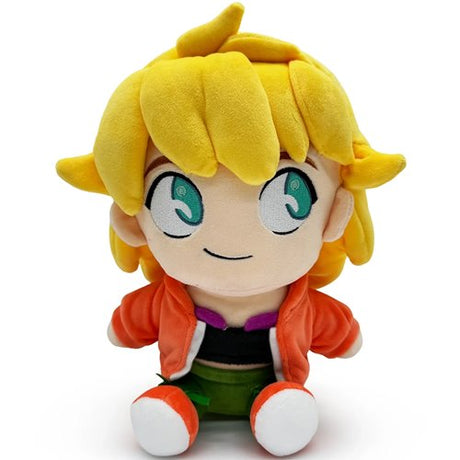
Explore Dorohedoro through Q Hayashida’s world, Nikaido plush and FigZero En, with a guide to contrasting character art and collectible formats.
A world whose contrasts are part of its appeal
Dorohedoro is Q Hayashida's manga, built around a world where grotesque transformations and ordinary relationships occupy the same space. VIZ introduces the Hole, the sorcerers who threaten its inhabitants, and Caiman, whose reptilian head and lost memories form a central mystery. Nikaido helps him, while En stands at the head of an opposing sorcerer faction. That starting premise is enough to understand the collecting theme without revealing later solutions to the story's mysteries.
The catalog brings together Nikaido Plush (9in) by Youtooz and Dorohedoro FigZero En by threezero. Nikaido appears seated, with her arms at her sides; En is an articulated, costumed portrait. Their difference suits a story in which familiar human gestures coexist with unsettling bodies. The collection does not need a battlefield to convey that contrast. A relaxed face beside a masked figure already suggests two very different ways of occupying the same world.
From the English manga to a collected body of art
VIZ published its first English-language volume on March 16, 2010, crediting Q Hayashida for story and art. This 176-page book belongs to the VIZ Signature line and carries a Mature rating. That date marks the English edition, not the manga’s original Japanese debut. The opening mystery is therefore available as a specific starting point, while the rating makes clear that a cheerful plush appearance does not describe the audience of the underlying story.
The publisher’s Dorohedoro Illustrations: Mud and Sludge, dated September 22, 2026, takes a different approach: 344 pages of color manga artwork, illustrations, sketches and paintings. It collects images rather than replacing the sequential story. For someone interested in Hayashida’s visual world, that distinction is useful. A character sculpture isolates a body in space; an art collection preserves settings, page compositions and the relationship between drawn figures and their surroundings. The art book is a reference beyond the two catalog objects, not an assertion that it is included with either.
Nikaido softened into a seated plush
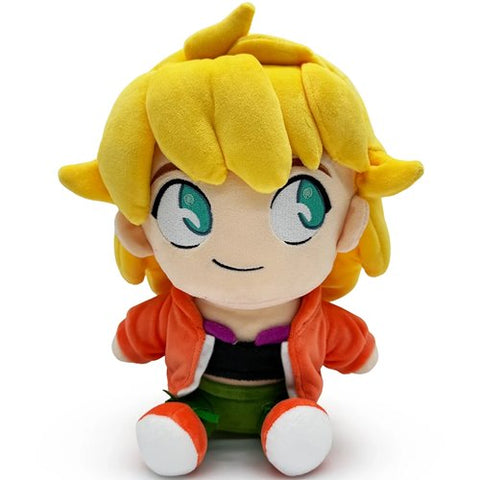
Youtooz describes this Nikaido as a nine-inch seated plush made with minky material and polypropylene cotton filling. Yellow hair, blue eyes, an orange jacket, green trousers, and orange shoes identify the design. The maker lists a November 30, 2024 release date. These details relate to the specific Nikaido Plush (9in) in the catalog, rather than to an articulated Nikaido figure or another manufacturer's interpretation.
The orange jacket frames a black top, while the trousers provide a darker block below the face. Nikaido’s upward glance is especially important in a seated design: the gaze keeps the portrait engaged with a viewer looking down toward it. Her legs extend forward rather than supporting a standing pose. This is a compact arrangement built around face and clothing color, with the soft outline replacing the angular folds a sculpt could reproduce. The nine-inch measurement describes this object, not a scale relationship to En.
En as a collaboration between drawing and sculpture
FigZero En is a one-sixth-scale figure with roughly thirty-five joints. Q Hayashida designed its original costume, while Masaki Apsy sculpted the head parts and smoke effect. Cloth clothing and weathered surfaces accompany interchangeable faces and masks, with movable eyes. The costume is not designed for removal. This is a creator-developed outfit for a physical release, rather than merely a claim that the figure copies the manga accurately.
The accessories extend the portrait beyond clothing: mushroom jars, a mushroom cane and a hookah-shaped mushroom container accompany Kikurage and a kennel. An open-mouth mask accepts the smoke piece; a closed-mouth mask offers another expression. Those details give En a small material world of his own. A display can emphasize the mask and smoke or place the character among the objects, rather than treating every accessory as something that must be held simultaneously.
How the anime carried the drawings into movement
In a July 2026 Anime Trending interview, director Yuichiro Hayashi described retaining the first season’s visual approach for the second while refining expressions. Background layouts, which he had handled himself, moved to MAPPA’s art team. Production assistants for 2D and 3D were separated so each could concentrate on that workflow. These are concrete changes behind an adaptation that might otherwise look like one continuous visual style.
Creative producer Yusuke Tannawa explained that 3D production helps a team share work and maintain consistency, but substantial shape changes demand specialist skill. Hayashi also highlighted camera movement. Animation producer Koya Okamura described improved CG expressiveness and stronger review processes. Seen beside merchandise, the distinction is revealing: a fixed sculpt needs a convincing form, while an animated model must retain character through changing viewpoints and performances. Neither task is solved simply by copying an outline from the page.
Faces, surfaces and the limits of a miniature
Nikaido’s textile face and En’s movable eyes place expression in different hands. The plush arrives with a settled gaze; an articulated portrait lets the owner alter the relationship between eyes, head and body. These are different experiences of character, not steps on a ladder from less to more authentic. Someone drawn to Nikaido’s welcoming expression may prefer the simpler object, while En’s mask variations reward closer inspection.
The strongest connection between them is the contrast in surfaces. Smooth fabric reduces detail into broad areas of color; worn clothing and sculpted parts introduce small interruptions that invite a closer look. A manga shelf can accommodate both without pretending they are actors in a scale-matched scene. Keeping some space around En’s accessories also leaves the mushroom shapes legible. The point is to let each object retain its own visual emphasis, rather than surrounding both with so many additions that their expressions disappear.
FAQs
Is Dorohedoro FigZero En the same kind of product as Nikaido Plush?
No. The catalog identifies different makers and formats: threezero’s articulated FigZero En and Youtooz’s seated nine-inch Nikaido plush. Their relationship is thematic, not evidence of a shared scale or interchangeable parts.
Is the first VIZ volume date the beginning of Dorohedoro worldwide?
No. March 16, 2010 is the publication date VIZ gives for its first English-language volume. It should not be presented as the original Japanese debut or as the launch date of the collectibles.
Sources
Pre-orders
Pre-orders are open
Reserve upcoming releases before they land. Full refund any time before it ships.