
Collection
Dick Tracy Collectibles & collecting guide
 Trading Cards
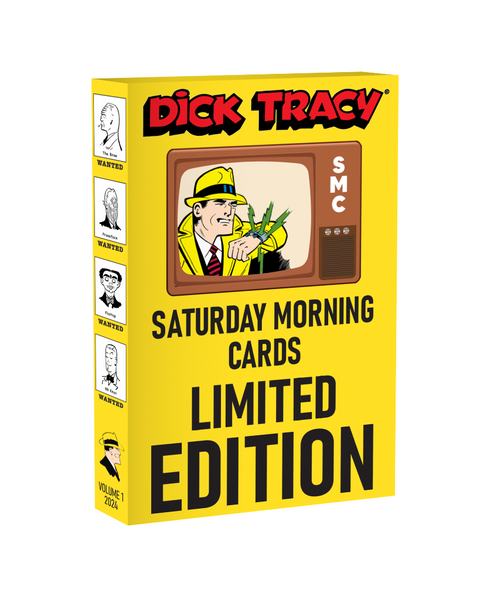
Saturday Morning Cards Dick Tracy Single-Card Box
Saturday Morning Cards
 Trading Cards
Saturday Morning Cards Dick Tracy Sealed Case (10 Single-Card Boxes)
Saturday Morning Cards
 Cards
Saturday Morning Cards 2024 Saturday Morning Cards Smc Dick Tracy Limited Edition Sealed Box
Saturday Morning Cards
 Cards
Saturday Morning Cards Dick Tracy Red LA Comic Con Exclusive Limited Edition Box #11/50
Saturday Morning Cards
Explore Dick Tracy’s newspaper origins, distinctive villains and fictional gadgets alongside Saturday Morning Cards’ designer-art releases.
A newspaper detective becomes a collectible subject
Dick Tracy begins with the visual economy of the newspaper comic strip: a recognizable face, a forceful pose, and a small space in which to establish danger or discovery. Chester Gould's detective is a useful subject for art cards because the character's identity does not depend on a large sculpt or a lengthy scene description. A carefully chosen portrait can suggest the wider world of investigations, adversaries, and fictional technology.
The catalog titles are Dick Tracy Single-Card Box and Dick Tracy Sealed Case – 10 Single-Card Boxes, both from Saturday Morning Cards. The character’s newspaper history provides context for the illustrations, without identifying them as original newspaper pages or a particular film adaptation.
Chester Gould and the beginning of the strip
The Chester Gould Dick Tracy Museum dates the strip's debut in the Detroit Mirror to October 4, 1931. Its biography describes Gould's years of work and rejected proposals before the detective concept was accepted by publisher Joseph Medill Patterson. That background connects Tracy to a working cartoonist's persistence rather than presenting the character as a finished franchise that appeared all at once.
Gould retired in December 1977 after more than forty-six years writing and drawing Tracy. His retirement marks the end of his own tenure, not the disappearance of the character. An art card can honor his creation without reproducing his artwork.
The adversaries are part of the visual vocabulary
The museum's villains reference names characters including Big Boy, Flattop, Mumbles, Pruneface, and Breathless Mahoney. Their contrasting appearances and names are central to the strip's exaggerated visual world. A villain-focused collection can therefore be as recognizably Dick Tracy as a row of portraits of the detective himself. That is a thematic observation, not confirmation that every named adversary appears in this particular card release.
When examining an actual card, look at how the artist uses outline, facial expression, lettering, and background to establish identity. The historical strip often connected outward appearance with moral character, a convention that can be discussed as part of its period rather than adopted as a judgment about real people. A useful caption identifies the fictional character and the artist's treatment. It need not repeat the original work's assumptions about what a supposedly good or bad person should look like.
Fictional gadgets add another collecting angle
Tracy's devices provide a different way to organize interest in the character. The museum dates the two-way wrist radio to January 1946 and documents other imagined tools, including a portable surveillance camera introduced in 1948. These references show how communication and investigation became visible elements of the fiction. They do not prove that a comic-strip device directly caused a later real-world invention.
For an art-led collection, a gesture toward a wrist device can carry narrative information even in a single image. It suggests a conversation taking place outside the frame and gives the viewer something to infer. If a card includes a gadget, identify the version shown before adding a historical date to its caption. Do not assume every small wrist detail represents the same device, or that an illustrated object is a functional feature of the collectible itself. The distinction between depicted technology and physical product is especially important with stylized art.
Dick Tracy Single-Card Box
One random designer-art card comes in a custom-printed acrylic case.
Use the card as an invitation to explore the comic
A rewarding Dick Tracy collection can connect a contemporary image with a specific question about the original strip. Which era introduced the character? Is a pose emphasizing investigation, communication, or confrontation? How does a new illustration simplify or exaggerate familiar shapes? Those questions give the object context without requiring a complete collection or a ranking based on resale prices.
FAQs
When did Dick Tracy first appear?
The museum dates the strip’s debut in the Detroit Mirror to October 4, 1931.
Are these cards original Chester Gould drawings?
Gould created Dick Tracy, but that history does not establish his authorship of the individual artwork in this product.
Sources
Pre-orders
Pre-orders are open
Reserve upcoming releases before they land. Full refund any time before it ships.