
The Collector’s Shelf
Child's Play
Explore Child’s Play’s 1988 film origins, Chucky’s screen craftsmanship, and Kidrobot’s sequel-branded boxed Good Guy plush.
Pre-order: Child's Play
All pre-orders →

Explore Child’s Play’s 1988 film origins, Chucky’s screen craftsmanship, and Kidrobot’s sequel-branded boxed Good Guy plush.
The original film establishes the unsettling gift
Child’s Play began its Chucky film story in 1988. The American Film Institute records a November 9 release, Tom Holland’s direction, and writing credits for Don Mancini, John Lafia, and Holland. ACMI’s synopsis centers the premise on Andy Barclay’s wish for a Good Guy doll and the dangerous object his mother brings home. This is the foundation for a collection interested in the contrast between an inviting toy and a horror character.
The Good Guy is frightening because it first belongs to a recognizable world of childhood wishes, television advertising and birthday presents. Andy sees a companion where adults see a manufactured toy. The story then asks the adults to believe something that appears impossible. A boxed collectible preserves that initial contradiction: the cheerful retail presentation remains visible even when the collector already knows what the character will become. The innocent version is therefore a deliberate choice, not an incomplete version of a damaged Chucky design.
A screen character built through physical performance
AFI’s production credits identify David Kirschner with the creation of the Chucky doll and Kevin Yagher with its design and execution. They also list Chucky puppeteers and credit Brad Dourif’s voice performance. This makes the original character a collaboration of physical construction, manipulation, and acting rather than a single static doll design photographed without transformation.
The original production notes, reproduced by BFI Southbank, describe nine dolls built for different jobs, including an inert toy, standing and walking versions, close-up hand puppets and expendable stunt doubles. Seventeen servo motors operated facial features. Separate puppeteers coordinated eyes, mouth, arms, hands, head and body; a slight mismatch could break the illusion. Chucky’s apparent independence was the result of a team moving together, not one universally capable mechanical doll.
That division of labor helps explain the difference between a film prop and a commercial character object. The screen performance was assembled from specialized constructions and selected camera angles. A plush keeps the identifying clothing, hair and face but abandons the machinery. Its softness changes the joke: an object associated with concealed danger becomes something visibly incapable of the physical performance that made the original unnerving.
From a student screenplay to a winter film shoot
In Mental Floss’s oral history, Mancini recalled developing the idea while studying at UCLA. His early version treated the doll as an expression of a child’s suppressed anger, rather than the vessel for a separate killer. The evolving screenplay and the finished possession story are different stages of the project. This history gives the familiar character a more specific origin than the idea of a frightening toy alone.
AFI records that production began in Chicago on January 7, 1988, with nearby rooms rented as warming centers during the winter shoot before work moved to Los Angeles. The distributor released the finished film on November 9, positioning it after Halloween and before Veterans Day weekend. Advertising progressed from brief spots to audience reactions and a more frightening presentation of Chucky. The character’s reveal was thus part of both the film’s storytelling and its public launch.
The catalog’s broad label contains a sequel-specific product
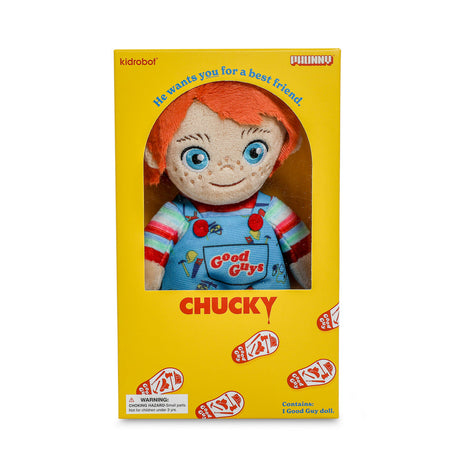
The catalog’s Good Guy Chucky — Standing Boxed Edition 7.5-Inch Phunny Plush is made by Kidrobot. Its manufacturer title specifies Child’s Play 2. Embroidered features, red hair, striped shirt and overalls preserve the friendly retail-toy exterior, presented in a Good Guys box.
How the original face became more human
Effects artist Howard Berger recalled that the original film used different facial expressions and progressively more human-looking heads. The hairline moved toward Brad Dourif’s appearance as the story continued. He also described the waist-up puppet as the most frequently used version, a reminder that convincing close-ups could matter more than a doll’s ability to walk across an entire room.
For a collector comparing Good Guy and menacing Chucky designs, the face is therefore more than a choice between happy and angry. Changes in expression and human likeness were built into the original effects work. The boxed Kidrobot plush stays on the toy-like side of that contrast. Its calm expression and tidy clothing recall the object someone might initially want, rather than the face that exposes the character’s intentions.
A boxed toy inside a story about a boxed toy
The box echoes packaging within Chucky’s fictional world, making the reassuring retail promise part of the display. Unboxing emphasizes the soft construction instead. The 7.5-inch measurement describes the standing plush, not its carton; neither presentation makes it a working film prop.
FAQs
Is this a replica of the original film’s working Chucky prop?
No. Kidrobot identifies a soft, embroidered Phunny plush associated with Child’s Play 2, packaged in a Good Guys box.
Does the 7.5-inch measurement describe the complete box?
It describes the standing plush. Packaging dimensions are separate.
Sources
Pre-orders
Pre-orders are open
Reserve upcoming releases before they land. Full refund any time before it ships.