
Collection
Beetlejuice Collectibles & collecting guide
Pre-order: Beetlejuice
All pre-orders →
 Vinyl Figure
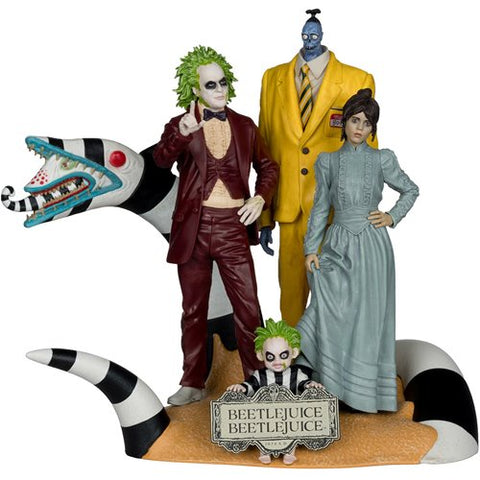
Beetlejuice Youtooz Vinyl Figure
Youtooz
 Plush
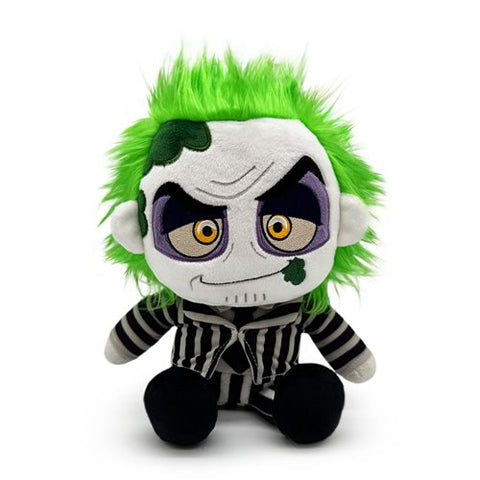
Beetlejuice Youtooz 9 Inch Plush
Youtooz
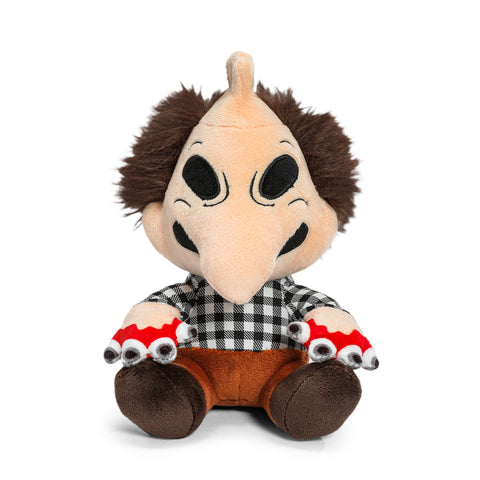 Plush figure
Kidrobot Scary Adam 7.5-Inch Phunny Plush
Kidrobot
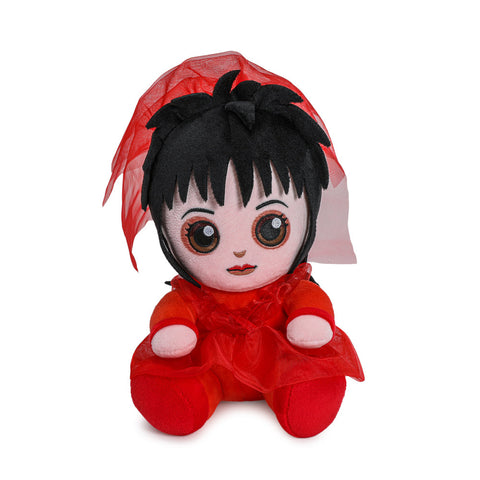 Plush figure
Kidrobot Lydia Deetz in Red Wedding Dress 7.5-Inch Phunny Plush
Kidrobot
 Plush figure
Kidrobot Bob the Shrinker 7.5-Inch Phunny Plush
Kidrobot
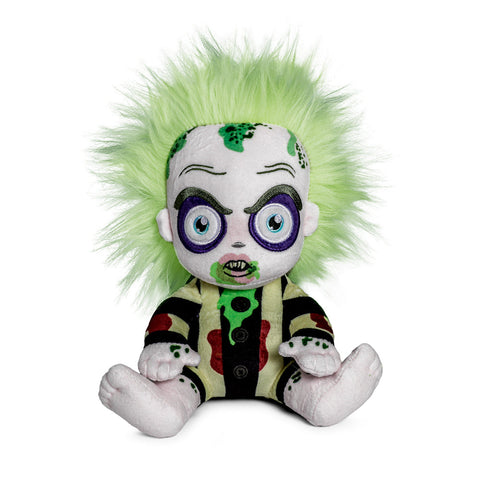 Plush figure
Kidrobot Baby Beetlejuice 7.5-Inch Phunny Plush
Kidrobot
Explore Beetlejuice through its celebrated makeup craft, returning film characters and the contrast between macabre screen designs and collectible plush interpretations.
A celebrated makeup achievement anchors the visual history
Beetlejuice’s visual history begins with Tim Burton’s 1988 film and its mixture of comedy, grotesque character design and handmade illusion. The Academy records its Best Makeup win at the 1989 Oscars. The award recognizes the film’s creative work, rather than later merchandise, but it helps explain why faces and bodies remain such strong subjects for collectibles. The local selection translates that imagery primarily into plush, where a frightening shape becomes a soft, compact object.
The sequel makes version labels especially useful
HBO Max’s official introduction to Beetlejuice Beetlejuice identifies Michael Keaton returning as Beetlejuice and Winona Ryder returning as Lydia Deetz, with Tim Burton directing. It describes three generations of the Deetz family returning to Winter River and introduces Lydia’s daughter Astrid. This establishes a continuation with returning and additional characters, rather than a reason to treat every Beetlejuice collectible as representing one identical screen moment.
The interval between the original film and the 2024 sequel also changes what a mixed collection represents. Lydia can connect the two generations, while a figure explicitly labeled Beetlejuice Beetlejuice points to the later film. Kidrobot’s Bob and Baby Beetlejuice entries sit alongside Scary Adam and Lydia’s red wedding costume in the catalog. The shared franchise name links them, but their individual subjects preserve different parts of its visual history.
A supporting character can be the strongest visual anchor
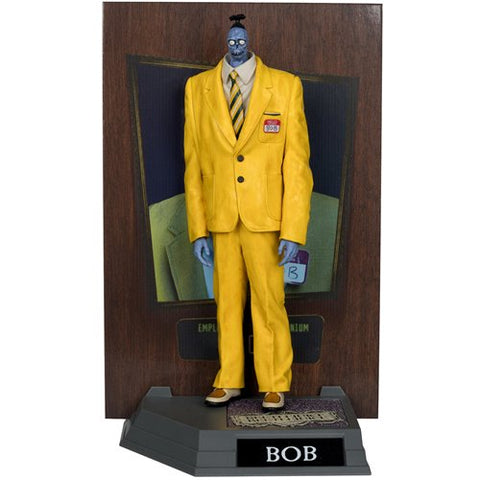
Kidrobot explicitly connects its Bob Phunny plush to 2024’s Beetlejuice Beetlejuice. The manufacturer describes Bob the Shrinker in a yellow suit with a tie and name tag, and identifies faux hair and embroidery among the plush’s details. Those features give the interpretation a concrete visual identity beyond the broad franchise name.
The catalog record is Bob the Shrinker 7.5-Inch Phunny Plush. His yellow workwear, tie and name tag are unusually ordinary details attached to an extraordinary body. That contrast fits the films’ treatment of the afterlife as a place with jobs and bureaucracy. In plush form the uniform gives the design a broad area of color, while the smaller face becomes the oddity within it. Bob therefore brings a different comic rhythm to the group from the title character’s conspicuously disheveled appearance.
Lydia’s outfit creates a different kind of recognition
Lydia Deetz in Red Wedding Dress 7.5-Inch Phunny Plush emphasizes fabric and costume rather than a distorted body. Kidrobot specifies a tulle gown and matching veil, with black hair and embroidered facial details. The saturated red creates a different focal point from Bob’s yellow suit and the title character’s stripes. It is a costume-specific portrait, so the dress is as important to its identity as Lydia’s face.
This is also a concrete example of how plush can preserve detail without copying a film costume at full scale. Tulle supplies a layered texture around a simplified body, while embroidery fixes the expression in a few readable marks. Paired with Bob, the two pieces become a comparison of clothing languages: formal bridal volume against a worker’s uniform. The relationship is visual rather than a claim that both characters occupy the same scene.
Scary Adam recalls a carefully constructed transformation
Scary Adam 7.5-Inch Phunny Plush represents Adam Maitland’s stretched face and eyeball-tipped fingers, as Kidrobot’s description confirms. Unlike Lydia, whose identifying feature is clothing, Adam’s recognition depends on altered anatomy. Baby Beetlejuice supplies another bodily variation in the catalog, showing how the plush selection extends beyond a single standard portrait of the title character.
American Cinematographer’s original 1988 effects account explains that Adam and Barbara’s face transformations used replacement animation. The team needed to move from the actors’ ordinary faces to already constructed final masks within a fixed number of frames. Individual sculpted heads were exchanged while wigs and clothing stayed in place, preventing distracting frame-to-frame movement. The sculptures were roughly half scale, with lighting adjusted to disguise their size. A plush of the finished face therefore preserves the endpoint of a highly planned sequence of physical shapes.
The title character in stripes, hair and surface detail
Beetlejuice Plush (9in) by Youtooz offers a larger seated version of the title character. Its official page dates the release to August 22, 2025 and describes a gray-and-black striped suit, pale face with green marks, purple-shadowed eyes and shaggy hair. Normal, long-pile and sublimated minky fabrics create different surfaces around the PP-cotton filling. Those are material differences a broad “plush” label would otherwise conceal.
The contrast with the Phunny selection is useful: Lydia relies on red tulle, Bob on a yellow uniform, Adam on a distorted face, and Beetlejuice on stripes and unruly surface detail. Together they show several ways to carry a screen design into cloth. The films’ effects artists likewise selected techniques to suit particular images. American Cinematographer describes a forced-perspective sand-planet set and mechanisms adapted to preserve the sandworm’s specified eye shape. Across these different objects, recognizable design comes from particular decisions about form and texture, not simply attaching the same franchise logo.
FAQs
Did Beetlejuice receive recognition for its makeup?
Yes. The Academy’s 1989 Oscars highlights identify Beetlejuice as the Best Makeup winner. That award concerns the film’s creative work, not later licensed collectibles.
Is Bob’s Phunny plush specifically connected to the sequel?
Yes. Kidrobot identifies Bob the Shrinker’s plush as based on 2024’s Beetlejuice Beetlejuice and describes his yellow suit, tie and name tag.
Sources
- Academy: 61st Oscars highlights
- HBO Max press room: Beetlejuice Beetlejuice
- Kidrobot: Beetlejuice Beetlejuice Bob Phunny Plush
- American Cinematographer: Behind the Iconic Effects of Beetlejuice
- Kidrobot: Lydia Deetz red wedding dress Phunny
- Kidrobot: Scary Adam Phunny
- Youtooz: Beetlejuice nine-inch plush
Pre-orders
Pre-orders are open
Reserve upcoming releases before they land. Full refund any time before it ships.