
Collection
BattleTech Collectibles & collecting guide
Pre-order: BattleTech
All pre-orders → Pre-order
BattleTech: House Steiner Squadron AeroSpace ForcePack
Catalyst Game Labs
Releases Feb 3, 2027
 Pre-order
BattleTech: Clan Wolf Fighter Points AeroSpace ForcePack
Catalyst Game Labs
Releases Feb 3, 2027
 Pre-order
BattleTech: Fire and Ice BattleMat 08 - Laze Base
Catalyst Game Labs
Releases Nov 25, 2026
 Pre-order
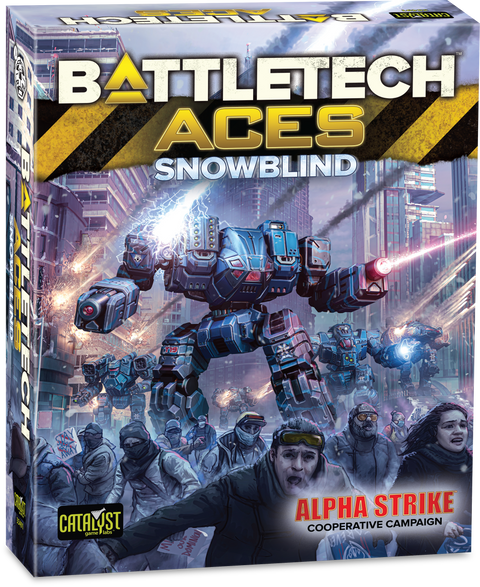
BattleTech: Aces - Snowblind
Catalyst Game Labs
Releases Nov 25, 2026
Explore BattleTech’s 1984 origins, miniature sculpting, metal casting, Classic and Alpha Strike play, and the 2026 Core Box direction.
A universe that develops alongside its machines
BattleTech dates its debut to 1984. Its central image is the BattleMech: a piloted war machine operating within a human interstellar civilization divided by competing powers. The setting has developed through named historical periods, including the Star League, Succession Wars, Clan Invasion and ilClan era. These are chapters within the fictional timeline, rather than interchangeable names for successive editions of the tabletop rules.
That distinction gives the miniature range unusual depth. A collection can follow the political history of the Inner Sphere or concentrate on the engineering personalities of individual machines. Fiction and tabletop combat inhabit the same broader chronology, with novels and Shrapnel magazine extending the setting beyond a single battle. Catalyst Game Labs develops and publishes the game. Its official overview treats the universe, rules and fiction as connected parts of an ongoing project, explaining why a new release may introduce a different historical viewpoint as well as a different sculpt.
Two different resolutions of the same battlefield
Classic BattleTech emphasizes the individual machine. Hex-grid movement and detailed record sheets make armor, weapons and ammunition part of the encounter's continuing story. Heat adds another consideration: movement and firing generate it, so a powerful turn can create problems for the turns that follow. The result is a battle in which damage changes what a particular machine can attempt, rather than merely moving it toward removal.
Alpha Strike compresses that information into unit cards and is designed to accommodate larger forces. Its Commander's Edition combines the fast-play rules with expanded material from the Alpha Strike Companion. The contrast is therefore one of granularity: following the fortunes of a few machines closely, or coordinating more units through a quicker representation of their capabilities. Both belong to BattleTech. The official tabletop resources provide quick-start material for exploring these approaches before committing to a more elaborate campaign.
From a three-quarter sketch to a complete BattleMech
Digital artist Dale Eadeh describes a deliberate separation between designing a machine and modeling it. A modeler may receive another artist's black-and-white concept drawing, then build a simplified block model to establish the major forms. Proportions are reviewed before panel lines and smaller details arrive. A drawing can suggest shapes that do not quite work in three dimensions, so a successful miniature sometimes requires departures from the original viewing angle.
The unseen rear also needs design work. Once the front and visible side exist, a screenshot of the rotated model can become the surface for another drawing pass. Eadeh's examples show how responsibilities vary: he drew the Peacekeeper before handing modeling to Ray White, while the Wolfhound involved both his sketching and modeling, with feedback from Anthony Scroggins. His first Catalyst sculpt was the Shadow Cat. These collaborations help explain why a miniature is more than a literal extrusion of familiar book art.
The craft behind metal miniatures
BattleTech's production history also includes hand-built masters and metal casting. In a 2026 interview, Iron Wind Metals COO James Redd contrasted older epoxy sculpts built over armatures with modern digital models. The digital approach still leads to physical manufacturing decisions: projecting parts may need separation so that a mold can reproduce them without tearing out vulnerable spaces.
Redd described masters leading to production molds, with preserved metal originals providing the reference when another mold is needed. Spin casting then distributes molten metal through the mold. Inspection remains a practical human step, and defective castings can be remelted. This is a different manufacturing route from the assembled plastic ForcePacks, not evidence that every BattleTech miniature shares one material or construction method. The catalog's BattleMaster C-Scale and Leopard-Class Map Scale DropShip labels likewise identify distinct formats; neither should be silently treated as an ordinary battlefield-scale ForcePack miniature.
The 2026 refit connects several generations of design
Catalyst developed the 2026 Starter Box, Core Box and Core Rulebook together, describing the project as a refit rather than a replacement edition. The Starter Box pairs the Hammerhead and Kontio, with reverse sides of its introductory record sheets previewing fuller equipment and rules. The Core Box adds the Sagas booklet, a setting primer built around new artwork and guidance on factions and styles of play.
Its eight machines also provide a compact history of how BattleTech designs travel between media. The Hollander and Rakshasa came through Technical Readout: 3055; the Uziel and Mad Cat Mk II originated in MechWarrior 4: Vengeance; the Vulture Mk IV Prime appeared in MechWarrior: Dark Age. Regent and Eris represent the ilClan recognition guides. Those connections make the selection more interesting than an arbitrary assortment of robots. Mystery Collective's catalog lists the Starter Box, Core Box and Core Rulebook separately, preserving their different roles.
A product range extending beyond individual ’Mechs
The catalog's Bug Mech Company ForcePack groups twelve machines under an insect-themed naming pattern. Catalyst's announcement specifies paired Stingers, Wasps, Spiders and Fireflys, two Locusts, plus a Cicada and Flea, with pilot and Alpha Strike cards. Reusing designs from several earlier boxes creates a new grouping rather than twelve newly invented chassis.
The Clan Wolf Fighter Points AeroSpace ForcePack moves the focus into the sky, pairing Chaeronea, Jagatai and Jengiz fighters. The Leopard-Class Map Scale DropShip represents transport infrastructure, with a flight base and acrylic stand in the announced pack. Aces: Snowblind takes another direction: an Alpha Strike campaign set in the Rasalhague Dominion's 3151 civil war. These products, alongside the catalog's Fire and Ice BattleMats, show how miniature groups, operational settings and battlefield surfaces develop together without all being the same kind of expansion.
FAQs
Does Alpha Strike replace Classic BattleTech?
No. The official tabletop introduction presents card-based Alpha Strike and detailed Classic play as two approaches within the same miniature universe.
What is distinctive about the 2026 Core Box selection?
It brings together machines introduced through technical readouts, computer games, the Dark Age game and ilClan publications, accompanied by the Sagas setting primer.
Sources
Pre-orders
Pre-orders are open
Reserve upcoming releases before they land. Full refund any time before it ships.