
Collection
Astro Bot Collectibles & collecting guide
Pre-order: Astro Bot
All pre-orders → Pre-order
Astro Bot Astro (Holiday) Funko Pop! Vinyl Figure
Funko
Releases Aug 31, 2027
 Pre-order
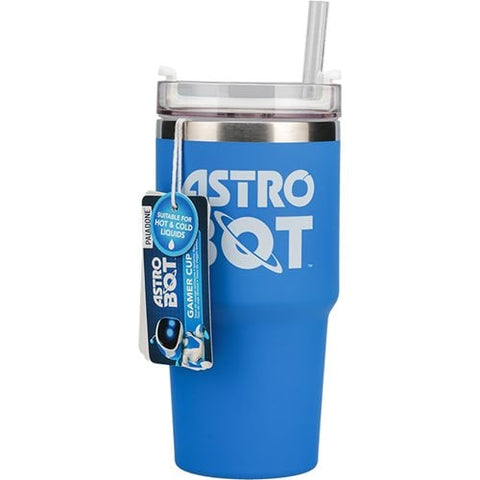
Astro Bot Gamer Cup
Paladone
 Pre-order
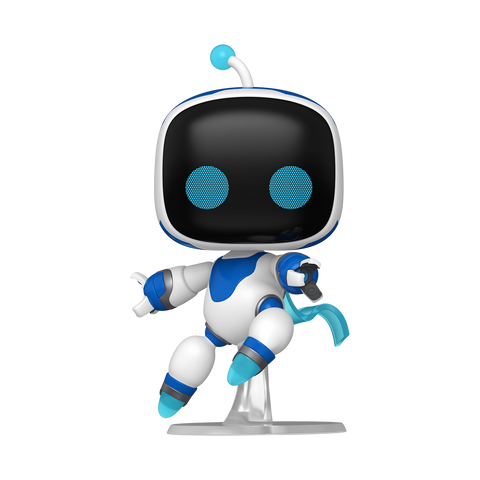
Astro Bot Jumbo 10-Inch Funko Pop! Vinyl Figure #1305
Funko
 Pre-order
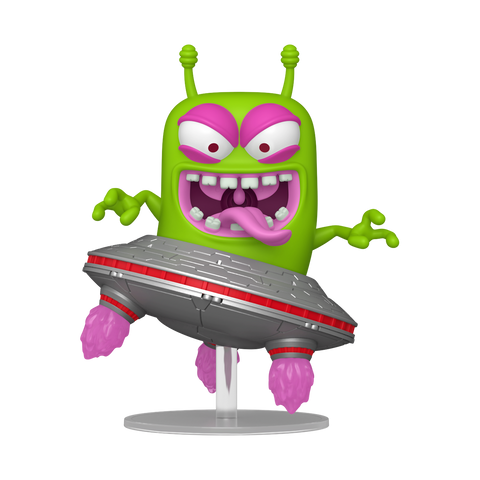
Astro Bot Space Bully Nebulax Funko Pop! Vinyl Figure #1307 (Specialty Series)
Funko
 Pre-order
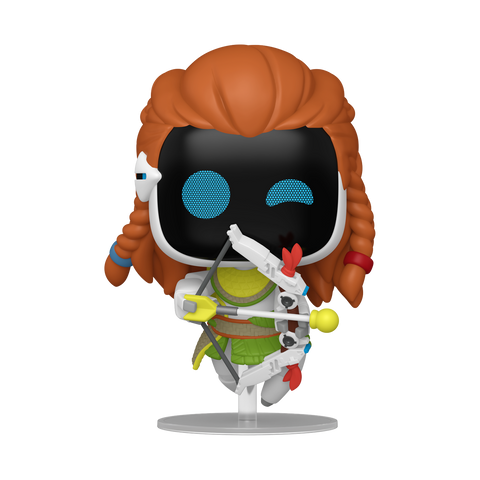
Astro Bot Machine Hunter Funko Pop! Vinyl Figure #1303
Funko

Trace Astro Bot’s controller-demo origins, artist-led robot design, gameplay-first power-ups, and PlayStation tributes through five Funko catalog releases.
From controller experiments to a platform hero
Astro began with interaction rather than a mascot brief. Team Asobi’s early experiments paired the DualShock 4 controller with the PS4 camera. Nicolas Doucet recalls prototype robots assembled from cylinders and eyes, followed by only five months to bring the demo into The Playroom. Their eventual appearance combined Sony-style robotics with large eyes and a toddler’s waddle. The small body needed to feel engineered and approachable at the same time.
The Playroom introduced the AR Bots in 2013. The Playroom VR followed in 2016, including a single-stage rescue platformer whose hero acquired blue markings, hover boots and a holographic scarf. Astro Bot Rescue Mission gave him a starring PS VR adventure in 2018, before Astro’s Playroom introduced PS5 players to the DualSense in 2020. This progression explains why the familiar robot belongs to a sequence of hardware experiments as well as a series of platform games.
The artists behind the rounded silhouette
Three Team Asobi artists explained Astro’s appeal in a drawing feature. Concept artist Toshihiko Nakai linked emotional warmth to rounded shapes and advised simplifying details. His face outline sits between a square and a circle, keeping the head structured without making it severe.
For her pop-art drawing, 3D artist Miho Kinebuchi used a heavier outline and recommended slightly enlarging the head and hands. Fellow 3D artist Mayu Kawaguchi emphasized mechanical detail against an easygoing silhouette. Her dancing illustration conveyed joy; she compared Astro’s large head with a baby’s. These are the game artists’ explanations of their drawing choices, showing how expression, proportion and outline work before adding a costume or accessory.
Doucet also describes a voice designed for an international audience. Astro’s robotic sounds combine English and Japanese fragments, broadly recognizable words and sound imitation. The team considered syllables and sounds that would communicate across languages. His apparent simplicity therefore extends to carefully constructed vocal expression as well as the visible design.
Gameplay comes before the finished creature
Team Asobi’s September 2024 development interview describes a practical route from a playable idea to finished art. Principal gameplay programming lead Masayuki Yamada said programmers first test simple models against the designers’ specifications. Artists develop them after the team establishes what is enjoyable. Principal art director Sebastian Brueckner likewise described building a world around gameplay scenarios, such as developing an icy interaction into a sea setting.
Senior animator Maki Murakami’s example was Handy-D: a climbing aid became a long-armed monkey carried on Astro’s back, with prototypes refined through playtests. Animation director Jamie Smith drew on children’s excited jumps and other expressions of joy. Those accounts give the animal-shaped abilities a production history beyond their cute appearance. They also explain why a small mechanical companion can be integral to a movement system, rather than merely decorating the hero.
Barkster turns a bulldog into an ability
The PS5 adventure launched on September 6, 2024, with an attacked mothership and a scattered crew providing the rescue premise. Its planets take Astro from forests and beaches to a huge hourglass and a singing tree. That changing terrain gives each power a distinct physical problem to solve, while the crew links the separate destinations into one journey.
Doucet’s reveal identifies Barkster as the Bulldog Booster: he enables an airborne dash powerful enough to break enemies, metal and glass. Other powers use different physical jokes, including frog gloves for distant punches and swinging, and a sponge that absorbs water until Astro becomes enormous. Funko’s Pop! Astro with Barkster preserves the named partnership in a vinyl figure approximately 4.6 inches tall, item 93671, box 1301. The catalog’s separate Pop! Jumbo Astro Bot stands approximately ten inches tall; its official identifiers are item 94086 and box 1305.
Cameos translated into a shared robot language
The cameo designs required more than placing familiar clothing on a bot. Doucet explains that organic features such as hair were treated as vinyl-like material so the guests belonged to Astro’s world. Blue LED eyes remained central. Characters whose expressions depended on visible pupils could instead wear masks. The adaptation preserves recognizable features while keeping the small robotic cast visually connected.
The Funko selection includes Pop! Dad of Boy, approximately four inches tall, and Pop! Machine Hunter, approximately 4.2 inches. Their box numbers are 1302 and 1303 respectively. Pop! & Buddy Tooled-Up Mechanic, box 1304, contains two vinyl figures measuring approximately 3.6 and 1.6 inches. Its paired format makes a different relationship visible from the single-character releases. Alongside Barkster and Jumbo Astro, these are the five catalog examples, spanning the main hero, an ability partner and named crew designs.
The tactile side of Astro’s visual world
Astro’s material character also depends on sensations a sculpture cannot reproduce. Sony’s launch account describes DualSense feedback distinguishing hard metal from softer watery textures, with adaptive triggers supporting the power-ups. The PS5 presentation combines that feedback with spatial audio, detailed environments and rapid travel between galaxies. A robot that looks solid is continually reinforced by what the player hears and feels.
Masayuki Yamada’s GDC 2025 session overview describes that coordination more precisely. Gameplay data is converted into controller feedback using custom tools and workflows, while haptics are aligned with sound, animation, models and effects. The listed examples include ground surfaces, power-up abilities and physical objects; the session also compares gameplay footage with feedback waveforms. This is a useful distinction when considering Astro’s design: the visible silhouette supplies recognition, but the original experience was built across movement, sound and touch.
FAQs
How does the Jumbo Astro differ from Tooled-Up Mechanic’s format?
Pop! Jumbo Astro Bot is a single vinyl figure approximately ten inches tall. Pop! & Buddy Tooled-Up Mechanic is a two-figure offer, with pieces approximately 3.6 and 1.6 inches tall.
What does Barkster do in the game?
Barkster is the Bulldog Booster, an ability partner that lets Astro air-dash through enemies and break metal or glass. That gameplay role is the context for Funko’s Pop! Astro with Barkster.
Sources
- PlayStation Blog: Evolution of Astro Bot’s character design
- Sony Interactive Entertainment: Astro Bot launch
- Funko: Pop! Astro with Barkster
- Team Asobi artists: How to draw Astro
- PlayStation Blog: Team Asobi’s gameplay-first development interviews
- Nicolas Doucet: Astro Bot’s 2024 reveal and power-ups
- GDC 2025: Masayuki Yamada’s DualSense session overview
- Funko: Pop! Dad of Boy
- Funko: Pop! Machine Hunter
- Funko: Pop! & Buddy Tooled-Up Mechanic
- Funko: Pop! Jumbo Astro Bot
Pre-orders
Pre-orders are open
Reserve upcoming releases before they land. Full refund any time before it ships.